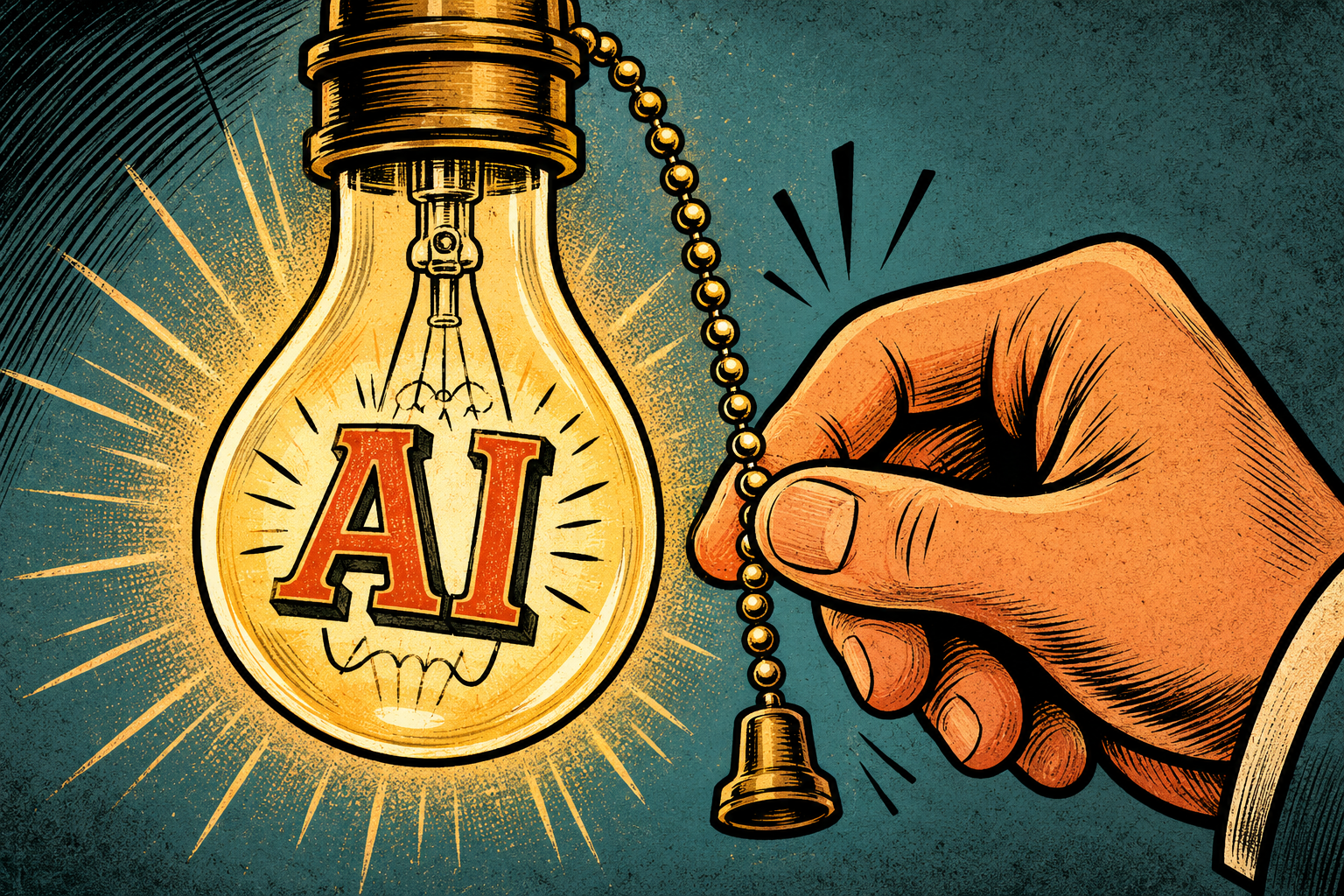
“It’s exciting to think about all of these amazing things we can do with AI as educators, but what happens if the lights go out on it?”
This is a paraphrased version of a question that was asked during a recent conference I attended with other educators who are experimenting with using AI to create more engaging learning experiences.
And it’s one that should make us all stop and think.
To put it into a context we can all relate to, consider how everyone loses their s%#t when the internet goes down — even for a brief moment.
If you’re in the classroom or in a boardroom presentation, you can’t pull up that slick slide deck you’ve been working on for the past two nights.
If you’re trying to pay bills, you can forget online banking. Instead, you have to start rummaging through boxes in the attic looking for your checkbook. (It’s in there somewhere. Just keep digging.)
And if you’re trying to send an urgent email to your boss, well — it looks like you’re either going to have to pick up the phone and talk to her or (if she’s in the same building) actually walk down the hall to her office for a face-to-face.
In other words, it SUCKS!!!
We’ve become dependent upon the internet for pretty much everything. So, when we suddenly find ourselves without access to it, panic sets in and feels a bit like this:
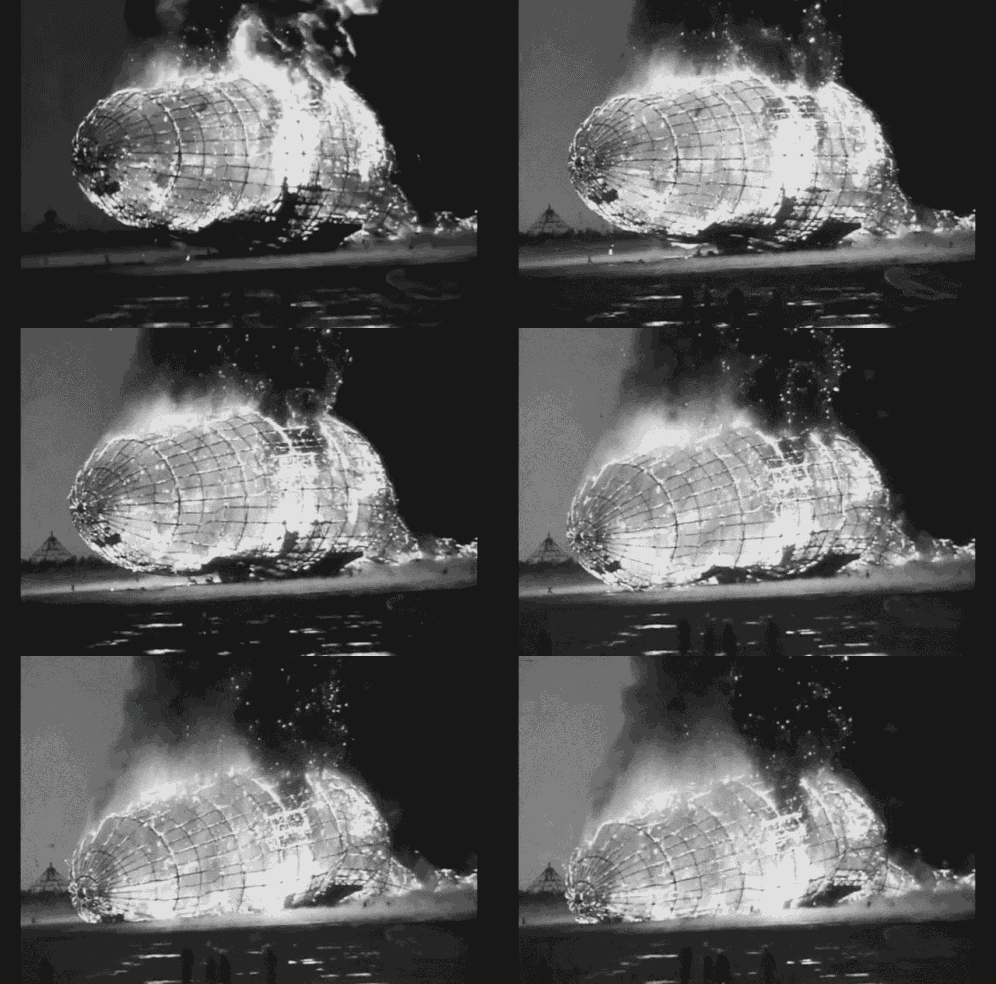
We’re still in the very early days of our AI journey. But — even now — there’s a temptation to rely on it for things we either don’t know how to do or that we simply don’t want to do.
So, this brings me back around to the question asked during the conference.
What would we do if the lights went out on AI — particularly a year or two from now when AI technologies have advanced to a level of sophistication we can’t even begin to imagine and have become an integral part of our daily lives?
For Those of Us Who’ve Been Around the Block a Few Times
Recently, I was teaching a class and, from my POV, things were going swimmingly.
The students were engaged.
I was freakin’ Yoda-like.
As the cool kids would say, things were POPPIN’!
And then the power went out — with 45 minutes left in the class session.

Not good. Not good at all.
At that point, I had to bring the patient — in this case, the class — back to life.

Rather than letting the students head out early, I just kept moving along with the topic we needed to cover that day. (To be fair, I think the students were shocked and dismayed that I didn’t just call “time of death” on the class that day, but teachers gonna teach.)
I walked over to the whiteboard at the front of the room, picked up a marker and kept moving along.
The only reason I was able to do this is because I know my discipline backward and forward. I’ve spent 30+ years in the trenches of business and higher ed doing the messy and challenging work of learning.
Of trying and failing, trying and failing again, and — sometimes, trying and succeeding.
Of being on the verge of quitting because a project feels too overwhelming — but I push ahead anyway.
Of swallowing my pride and asking others who are MUCH smarter than me for help.
In other words, I’ve done the work it takes to build a vault of knowledge ( + some useless trivia) in my head.
You’ve done it, too.
So, for us, if the lights go out on AI, we know what to do next — because we’ve done it a THOUSAND times before. AI has been the amplifier for us — not the replacement.
This is why I don’t worry too much about what we of a certain age and a certain level of experience would do should the lights go out on AI. It would suck — but we’d be fine.
How about others, though? The folks who are younger than us and are just starting out in their chosen profession? Those who are entering a new field after spending the past 20 or 30 years in a completely different profession that’s no longer needed? (Can we say “retraining” or “reskilling”?) Or those who’ve been able to hide their skill deficiencies with the help of AI?
This is where things get tricky.
For Those Who Are Using e-Bikes to Climb Hills Instead of Just Old-Style Pedaling
Before anyone gets all judgy about my e-bike reference, hold for a moment, please.
If you have an e-bike, that’s awesome! Seriously. There are a lot of great reasons to use them — including encouraging more people to get outside in the fresh air.
But, hear me out: The people I often see riding them are fit, healthy human beings who just want a way to get from A to B faster.
There’s nothing wrong with that — unless they’re riding their e-bike on a public sidewalk or greenway, zipping by and between pedestrians who just want to go for a quiet stroll. OR when they ride on streets without looking where they’re going, and surprising unsuspecting drivers who are just trying to turn right or left at a stop sign.
AI is becoming the e-bike of education and industry.
It makes it easier for a student to complete a difficult assignment without the need to understand anything about the topic.
It allows an employee who lacks certain skills to hide in plain sight.
What happens to them if the lights go out on AI?
In technical language, they’re pretty much screwed.
THIS is what I’m hell-bent on preventing.
I’m a HUGE proponent of using AI to create and enhance learning experiences. I want to use it to build tools and opportunities that make learning something people want to do — even when it gets hard.
I start each semester with an exercise called “What AI Can’t Do” — an activity that helps students understand why getting an education and doing the messy work of learning is more important now than ever.
The same goes for businesses. Employees should be AI literate — not AI dependent. There’s a HUGE difference between the two.
Here’s the Thing About the Lights Going Out
I’m not actually worried it will happen. AI isn’t going anywhere. But the question of what would happen if the lights did go out on AI is worth sitting with. Because if the thought of losing AI feels threatening, it’s probably a signal that we’ve stopped filling our own knowledge banks and started borrowing from the great AI bank in the sky (or cloud?? And that’s the real problem worth solving.
AI amplifies what’s already there. For the person who’s done the work — who’s failed at things, learned from it, and built real knowledge over time — it’s genuinely extraordinary.
A force multiplier.
The best thinking partner you’ve ever had.
But it can’t create depth that doesn’t yet exist. And it can’t save you when such depth is required.
So, I don’t want people to be afraid of AI. But let’s make sure the lights going out wouldn’t matter — because what you know lives in that big brain of yours, not in a remote server somewhere.
Try This Before Your Next Meeting, Class or Project
Ask yourself — or your team, or your students — one question:
If AI disappeared tomorrow, what would I still know how to do?
That’s it. All that’s required is just an honest answer.
What shows up in that answer is your foundation — the knowledge, judgment, and hard-won experience that’s genuinely yours.
What doesn’t show up is the gap you or your students or your organization need to work on. Not busywork. The real kind: the reading, the practice, the mistakes, the figuring-it-out-the-hard-way that actually builds expertise over time.
I call this the “What AI Can’t Do” audit, and I use a version of it with my students every semester. It’s not about downplaying or criticizing AI. It’s about knowing where you, your students or your organization actually stand — so that when you do use AI, you’re layering it on top of something real: your own thinking, your own judgment, your own ability to evaluate whether what AI gives you is actually any good.
AI literate vs. AI dependent. There’s a huge difference between the two — and knowing which one you are is the first step toward using AI as an amplifier — not a replacement.
Ready to Find Out Where You Actually Stand?
I’ve built two free resources to help you figure out exactly that.
If you’re an educator, start here: Start with What AI Can’t Do — a practical guide for bringing this question into your classroom in a way that changes how your students think about learning.
If you’re a business leader or team manager, this one’s for you: AI Literate. Not AI Dependent. — a framework for making sure your organization is building on a real foundation, not just borrowing one from a chatbot.
Both are free. Both are built on the same idea: AI works best when the thinking is already in place.