
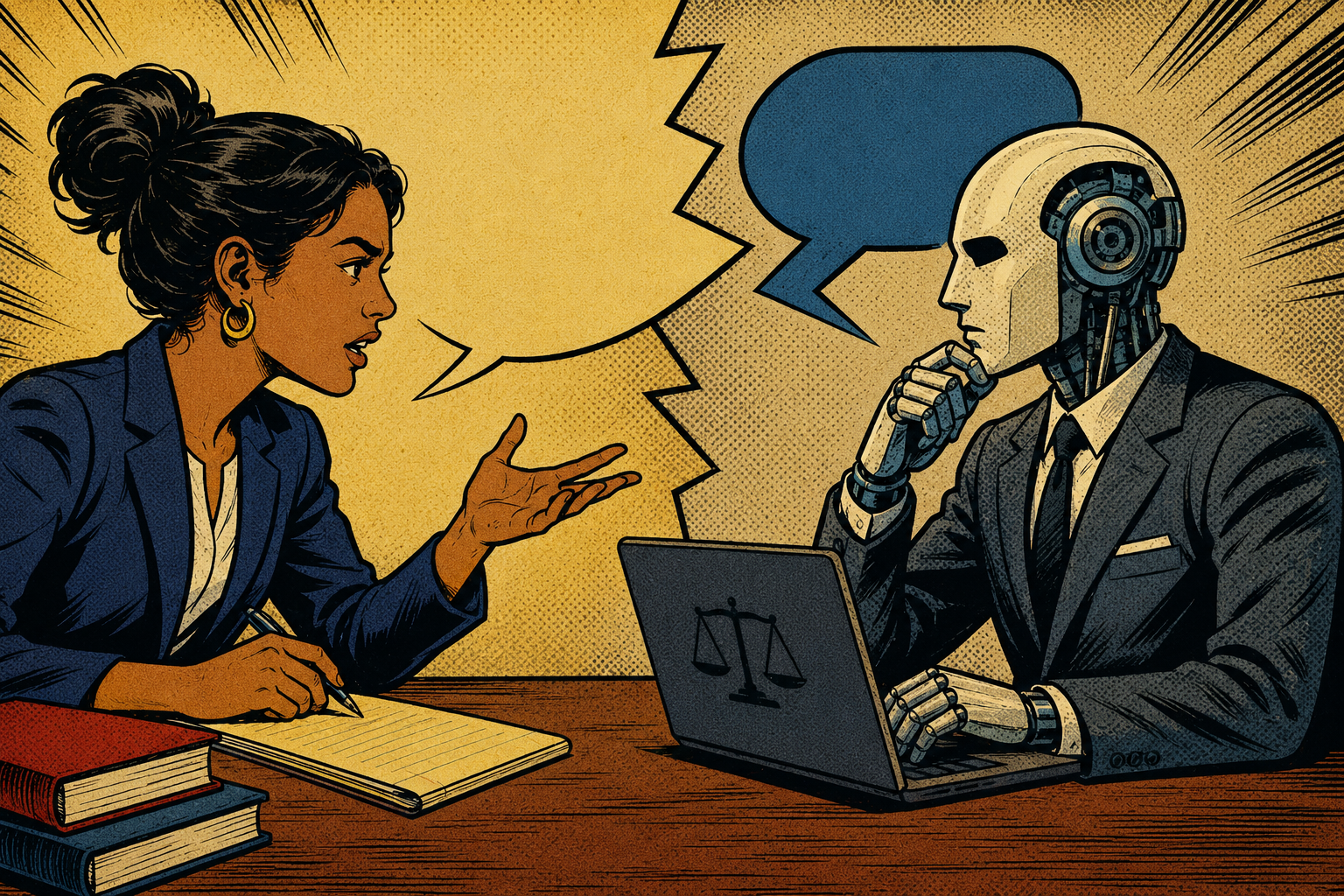
I must admit — when I first started thinking about how to redesign an assignment for the online, asynchronous media law class I’ve been teaching this summer, I found myself getting really frustrated.
It’s hard enough getting students to engage with course materials in the classroom.
With asynchronous online courses, this challenge is taken to an entirely new level.
In this case, my students were learning about defamation law. From my video lectures, they knew the elements that a plaintiff would have to prove in order to win a defamation lawsuit — publication, identification, defamatory meaning, fault, falsity, damages.
They could list them.
They could define them.
But, those two things are NOT good indicators of understanding.
What I ultimately wanted the students to be able to do was apply these elements to a messy set of facts and effectively defend their “case” when someone pushed back.

In a face-to-face classroom, I can do that pushing. (Students in the class can, too.)
I can ask, “But how do you know that?”
I can say, “Is that really a factual claim, or is it opinion?”
I can play devil’s advocate until they either strengthen their argument or realize they don’t have one yet.
Online? That friction disappears. Students complete the work on their own time, in their own spaces, and submit something that might be very well-written, but lack adequate legal reasoning.
To be fair, they aren’t law school students. (At least not yet!) In fact, for many of them, this course is the first time they’ve been asked to read, understand or apply any type of legal documents and precedents.
BUT — as future communications professionals — they need to have a solid grasp on the laws that impact the industry they’ll be entering.
So, back to the need for pushing and challenging students —particularly since that’s one of the most effective ways to get learning to actually stick.
I began to wonder: Since I can’t be in the room with them, what if AI could be the one doing the pushing?
What I Decided to Build
I decided to build a custom GPT for this assignment.
Not a media law tutor.
Not a general “course helper.”
I trained the GPT to play one specific role: opposing counsel.
I gave students a hypothetical case. In it, the plaintiff was Maya Dray, owner of a fictional small business called Harbor Tides. A former vendor of hers — Jordan — posted a viral TikTok accusing Maya of stealing designs, lying about why certain artists were being rejected from participating in an upcoming art fair, and excluding artists who spoke up about it.
The students played the role of plaintiff’s attorney. So, they represented Maya.
The GPT’s role was opposing counsel. So, it represented the defendant. Its job was NOT to explain defamation law to students. Instead, its job was to challenge whether the students could prove their case.

That distinction — challenge versus explain — is what made it work.
A GPT course tutor would answer questions.
The Opposing Counsel GPT asks students: How do you know the statement is false? Is Maya a private figure or a limited-purpose public figure? Could this be characterized as opinion? Where’s your evidence of actual damages?
The GPT wasn’t there to help students write better sentences. It was there to make them defend their reasoning before they submitted anything.
The Opposing Counsel GPT asks students: How do you know the statement is false? Is Maya a private figure or a limited-purpose public figure? Could this be characterized as opinion? Where’s your evidence of actual damages?
How the Assignment Actually Worked
The assignment ran in three stages. (BTW, this structure matters if you want to try something like it.)
Stage 1: Rapid Issue Spotting.
Before students ever opened the GPT, they completed a timed exercise in the LMS — eight open-ended questions answered in order, with a 20-minute window to complete them all. No polished writing. Just initial thinking: What are Maya’s strongest arguments? Which element looks weakest? What’s the defendant’s best defense? Which Supreme Court case applies?
The structure was intentional. The time limit and the sequential questions were designed specifically to limit the temptation to use AI for the initial case analysis. Also, students only received the link to the custom GPT after they submitted all eight responses.
Could someone still find a way to use AI anyway? Sure. No design is foolproof. But this at least created a meaningful barrier. It also captured their thinking before the GPT entered the picture, which mattered for everything that came after.
Stage 2: The Opposing Counsel Challenge
Students pasted their issue-spotting responses from the LMS exercise into the GPT and asked Opposing Counsel to push back from Jordan’s side. The GPT was instructed to identify weak reasoning, raise defenses, and ask harder questions. It was also explicitly instructed not to write any portion of the assignment for them.
That guardrail matters.
If a student asked the Opposing Counsel GPT to draft their legal argument, it redirected by saying: “My role is to challenge your reasoning, not write it. Show me your weakest element and let’s start there.”
Stage 3: Final Argument Packet
The final assignment submission included students’ original issue-spotting from the LMS activity, a summary of the exchange they had with the Opposing Counsel GPT, a revision table (what changed and why), their final argument for the plaintiff, and a short reflection.
The revision table was the part I cared most about. It made it possible for me to see the evidence that something moved between Stage One and Stage Three regarding how students were understanding the elements of a defamation case.
Why the Hypothetical Was Designed to be Complicated

When creating the hypothetical for this assignment, I made a deliberate choice with the facts. I gave students enough to argue for Maya — but also enough complications so that the Opposing Counsel GPT had real material to work with.
Jordan (the defendant represented by Opposing Counsel) could argue the TikTok post was opinion based on personal experience — not verifiable facts. He could argue that Maya had become a limited-purpose public figure by promoting her business publicly, appearing in local media, and hosting community vendor markets. And he could also argue that his post addressed a matter of public concern — warning other local artists about how a business treats vendors.
None of those defenses were slam dunks. But, neither was Maya’s case.
That ambiguity was the whole point. Legal reasoning isn’t checklist completion. It’s arguing for a position while anticipating — and surviving — the other side’s best shot.
How Students Reacted

Students reported that the custom GPT helped them better understand what a plaintiff actually has to prove in a defamation case — not just what the elements are. They learned what it takes to satisfy each of the required proof elements with facts rather than assertions.
One thing that came up repeatedly: Students realized they were assuming falsity rather than proving it. A student might initially say Maya could prove the statements were false because she denied them. Opposing counsel would push back: Is Maya’s denial enough? What would show the statement is provably false — not just disputed?
That’s the gap I was trying to close. And it closed faster through friction than it ever did through explanation.
What I Learned About Building Custom GPTs That Actually Teach
If you’re thinking about trying something like this, here’s what I’d tell you — not as a framework (I have complicated feelings about turning everything into a framework) but as the things I actually learned from doing it:
Start with the thinking move, not the tool.
What’s the specific cognitive work your students need to practice? For me, it was legal application under pressure. That told me everything about what role the GPT needed to play.
Give the GPS a role with friction built in.
“Helpful assistant” is too broad and, honestly, too easy to misuse. Opposing counsel, skeptical client, confused audience member, grant reviewer — roles that create productive resistance are different from roles that reduce it.
Require first-pass thinking before AI enters.
This isn’t about catching cheaters. It’s about making sure students have something to bring to the exchange. The GPT challenge is only as useful as the thinking students arrive with.
Make AI the challenge, not the author.
The guardrail — “I can challenge your reasoning, but I won’t write your argument” — has to be explicit and enforced in the GPT’s instructions. Otherwise, many students will look for and find the path of least resistance.
Make revision visible.
The revision table was the assignment inside the assignment. It’s where I could actually see whether learning happened — not just whether the final argument was well-organized.
The Larger Point

I don’t think every assignment needs a custom GPT. I also don’t think every online teaching problem is an AI problem.
But this one was — because what was missing from my asynchronous course wasn’t content. My students had content. What was missing was friction. The experience of having your reasoning challenged before you decide it’s done.
This custom GPT gave them that.
Not because it was broad, but because it was specific.
Not because it gave them answers, but because it made them argue.
Yours in building things that push back in ways that matter,
Michele
P.S. — Have you tried giving a GPT a role that creates resistance instead of assistance? I’d love to hear what you’ve built — or what you’re still trying to figure out. Drop it in the comments.
P.P.S. — If reading this made you think about a course that needs more than just a GPT — one that’s grown a bit stale and could use a fuller refresh — I built a free tool that can help. It’s called The Course Refresher. Paste in your syllabus, answer a few questions, and it hands you back a customized blueprint: session by session, three classes built all the way out, and ideas for specific AI-powered tools worth building named right where they’d do the most good. Get started for free here.