“I’m afraid.”
As a college professor and entrepreneur, I hear this a LOT during any conversation I have about AI.
“I’m afraid that the skills I’ve worked decades to master are going to be taken over by AI.”
“I’m afraid I won’t be able to support my family if I’m replaced at work by AI.”
“I’m afraid there won’t be a place for me anymore.”
I must admit that, in addition to hearing about this fear, I’m also experiencing it.
Along with the work I do in higher education, I’ve also had a steady roster of new and long-term freelance writing clients for decades.
Within the past year, though, that roster has grown increasingly quiet.
I haven’t raised my rates — which were already very reasonable. I haven’t changed turnaround times — which were already some of the fastest in the industry. And the quality of my work is the best it’s ever been. (If I do say so myself.)
So, what’s going on?
I can’t prove that this silence is due to AI. Nobody called to tell me they’d swapped me out for ChatGPT. But I do know this: AI can now do almost everything I used to do for those clients. Quickly. Cheaply. And sometimes pretty damn well.
I’m not the only one experiencing this. In a study published in the July 2025 edition of the Journal of Economic Behavior & Organization, researchers found that the overall demand for writers and translators dropped by 20% to 50%, with the largest reductions hitting experienced professionals rather than beginners. The reason? These seasoned freelancers had more mastery of their craft and, therefore, charged higher fees for their work. So the better a freelancer is, the more vulnerable they become—particularly with tasks now considered commodities, such as writing, design, coding, etc.
So when someone tells me they’re afraid about what’s going to happen with AI, I don’t tell them it’ll all work out. I don’t know that. Neither does anyone else.
We’re all being dragged kicking and screaming into the pit of fear known as UNCERTAINTY. And most of us tend to get our asses kicked when we enter that arena.
We try to avoid uncertainty at all costs. It’s scary. It’s disorienting. And it makes us really uncomfortable.
But the transformational technical changes that AI is fueling are coming at us faster than we can process what they’ll mean for us, for those we love, and for the world.
If uncertainty were a combustible substance, AI has thrown an entire box of lit matches into it.
We’re surrounded by forecasts, warnings, advice and increasingly urgent calls to prepare.
But prepare for what, exactly?
There’s an assumption that if we can figure out what the future with AI will look like, we’ll know what to do — and the uncertainty we’re feeling will simply go away. POOF.
But we don’t know — because we can’t predict the future.
And maybe we don’t have to.
The AI forecasts flooding our inboxes and podcasts can inform our decisions and actions. But they can’t eliminate uncertainty.
In the end, the ultimate impact of AI will depend less on what the technology can do and more on how people, organizations, schools, governments and markets respond it.
It’s important for us to realize that technological possibility doesn’t equal inevitable outcomes — economic or otherwise.
For those of us who were born in the 20th century, we’ve lived through an enormous number of transformative technological changes without knowing exactly where they would lead.
So, this isn’t our first rodeo.
We Didn’t Know What That Wacky Thing Called “The Internet” Would Do, Either.
It was the early 1990s.
Beanie Babies were all the rage.
Home Alone hit theaters nationwide — with no clue that it would eventually become a holiday classic.
The Sony Discman was a must-have accessory.
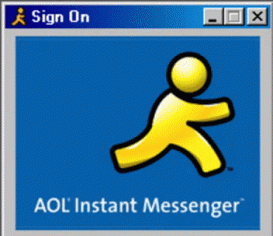
And finding an AOL disc in your mailbox every other week or so was the norm. It came with 15 hours of free internet access. All you had to do was install the AOL browser software and you were able to immediately welcome the world into your living room, office, kitchen or wherever your bulky desktop computer was housed. (Granted, access was through a dial-up connection. So, “immediately” is a subjective term here.)
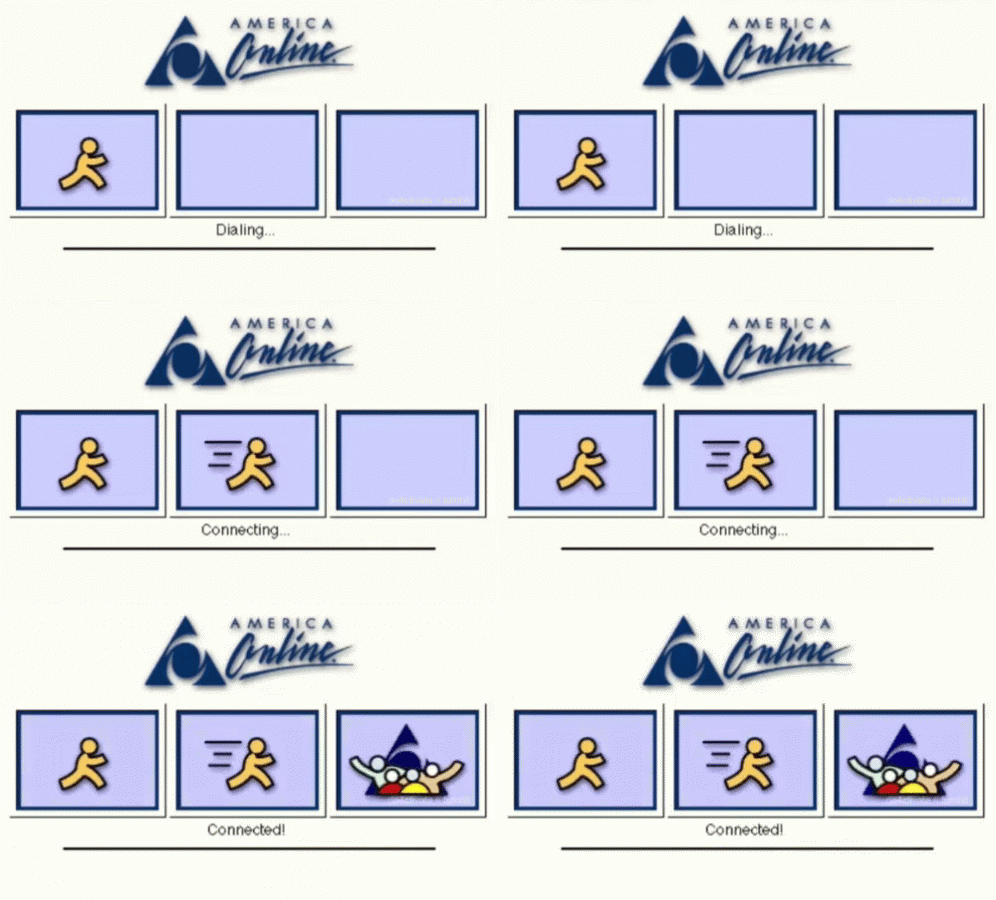
That seems like forever ago. And, to be honest, it sort of was. In fact, there’s now an AOL direct mail piece housed in the Smithsonian’s American History Museum.
I was in law school when I first installed AOL on my computer. And it flipped my world upside down and sideways. The fact that I could now access legal research databases in the comfort of my own home, anytime of the day or night BLEW. MY. MIND. Where had this internet thing been all of my life??
I also remember the first instant message I sent to a friend who was living on the other side of the country. She replied. Then I replied. And it went on and on. Long-distance calling still cost extra then, which limited how much time we could afford to spend chatting on the phone. But with AOL and instant messaging, we were able to chat away for as long as we wanted. FOR FREE!
There was a lot of excitement about this new technology. And there was also quite a bit of fear. No one knew what the internet was going to mean for jobs, school, or anything else.
But we learned how to live and work with the internet through experimentation, adaptation, institutional and societal change, and experience.
Today, we can’t imagine not having internet access. But it’s a blessing and a curse. It has made so many things possible — from new friendships to new discoveries. But it has also become a tool for spreading disinformation, stealing personal information, and splitting humans into competing factions.
AI is a different animal, though. It can perform cognitive tasks — like writing, analyzing, creating, advising, etc. The internet can spread knowledge. But AI can replace some of it.
That’s why this round of uncertainty feels so much heavier.
This Isn’t Just About Learning Another Technology.
AI disruption is real.
People aren’t simply worried about having to learn yet another technology. (If only!)
Instead, they’re worried (or perhaps even terrified) about losing their jobs, professional identities, sense of purpose, and ability to support themselves and their families. That’s a really shitty place to be.
When you’ve spent decades developing expertise in a field, watching AI swoop in and do much of that work really, REALLY well can feel DEEPLY threatening. Trust me. I’m in it.
Here’s something that caught my attention recently: Earlier this fall, Elon University’s Imagining the Digital Future Center surveyed 1.158 U.S. adults who were employed either full-time or part-time. Results in the report, titled “Americans Fear AI Will Hollow Out the Meaning of Work“, showed that only 8% of respondents had little or no confidence in their ability to learn new skills that would make it possible for them to adapt to changing needs in their current job. But 19% — more than twice as many — weren’t confident they’d control their career path.
Read that again.
Most of us believe we can learn. What we’re not sure about is whether we’ll get a say in what our career path will be.
So we try to protect the job we have. We want certainty. (Me? I CRAVE certainty.) But frankly, I think protecting the job is wasted effort — even though I completely understand the impulse.
There’s a difference between protecting a specific job and developing the capacity to keep creating value as work changes. Protection can’t be guaranteed. But capacity can be built. And this is the approach I’m doubling down on in my own work.
In a recent post, I wrote about why we should stop chasing AI in a futile effort to beat it at the skills we’ve spent decades mastering. It’s faster — and sometimes better. What I’m looking at now is the other half of that argument: What we should chase instead.
Adaptability and Agency: A More Useful Way to Prepare
Okay. Pull up a chair. It’s vocabulary time!
First, “accountability.” A-C-C-O-U-N-T-A-B-I-L-I-T-Y
“You just need to adapt.” This phrase gets thrown around quite a bit when big changes are on the horizon. It’s the prettier version of “Pull yourself up by your bootstraps.”
But when it comes to the AI era we’re living in, adaptability means something different. Instead of referring to a frantic effort to master every new AI tool or application, it’s about the capacity to notice change, question assumptions, learn, experiment and adjust. It’s what lets us see when our usual methods have stopped working.
Second, “agency.” A-G-E-N-C-Y
Agency is the capacity to make meaningful choices and take action when circumstances are changing — even when things are “jump-scare” frightening.
It shifts the question from:
“OMG! What’s AI going to do to me??”

to
“What can I do AND what kind of value can I bring with what I know, what I can learn, and the AI tools now available?”
Adaptability and agency belong together.
Adaptability without agency can pull us into an endless loop of reacting.
Agency without adaptability makes us stubborn enough to continue pursuing approaches that stopped working a few miles back.
Remember that 8% vs. 19% gap? Adaptability is the part most of us already trust ourselves with. Agency is the part we’re missing.
Adaptability helps us recognize when circumstances are changing. Agency helps us decide what we’re going to do about it.
The Real Opportunity: Become Better at Creating Value — and Talking About It
I’m not going to pull any punches. AI might very well reduce the economic value of certain tasks — even those that require significant expertise.
BUT — the value you or I or anyone else brings to the marketplace isn’t forever tied to a particular skill. It can also come from recognizing meaningful problems, understanding people, exercising judgment, and noticing what others miss.
Here’s a hypothetical — yet arguably realistic — example:
Kate is a communications professional at a marketing agency. She has 25+ years of experience in the field, a bookcase full of awards, and an uncanny gift for finding and telling the stories of any brand, product or service.
But during the past year, clients have hired her team for less and less work. Curious about why, Kate picked up the phone and called several longtime clients she trusted. She asked them one simple question: “Why aren’t you coming to us as often as you used to?”
Across the board, the answer was cost. Now that ChatGPT and Claude could produce quality content quickly and cheaply, paying an outside agency for the same thing didn’t make financial sense.
Kate had suspected as much. Now she knew. Her clients saw her agency as a content generator. And that’s exactly the type of work AI replaces.
So, Kate found herself looking at two distinct options:
- Get out of the agency business and try to find an in-house marketing job somewhere — unless they were being replaced by AI, too.
- Figure out what she and her team bring to the table that goes beyond content creation — and learn how to communicate that value clearly and effectively.
She decided to explore the second.
Here’s where Kate got stuck — and where I think a lot of us get stuck. She sat down to list what her team offered beyond content and wrote: “We understand audiences. We know how to evaluate messages.”
It read like every agency’s capabilities page. It didn’t sound like her at all.
So she tried something different. Instead of listing skills, she went looking for moments when something went right because she was there.
One came to mind almost immediately. A few years earlier, Kate sat in the final review for a regional health system’s marketing campaign. Everything was approved and ready to launch. But Kate noticed the head of nursing, who was also in the room, hadn’t said a word throughout the entire meeting. Afterward, Kate asked her about it. What she learned was that the campaign’s message about “convenient care” felt like a slap to nurses who’d been working doubles through a staffing shortage. “Convenient” was NOT how they’d describe the level of care they were providing. So, Kate took that insight and rebuilt the campaign’s story around the nurses who were actually delivering that care. And, when the campaign launched, the hospital staff — including nurses — shared it. Patients noticed. And so did the hospital’s other stakeholders.
AI wasn’t in that final review meeting. Kate was. And that was the difference maker.
This kind of value doesn’t show up on a list of deliverables. Noticing. Judgment. Trust. And once Kate remembered that specific moment, she started recognizing it in others. She began to see that the value she and her team could deliver beyond what was replaceable by AI included helping clients improve a process, design a new offering or look at a problem from a different angle. And, if they used AI as a partner, her team could prototype and test ideas that used to be too expensive to try.
Does this new approach work? That’s what Kate will be exploring. If it does, great. If it doesn’t, she’ll go back to the proverbial drawing board. Either way, she won’t sit around waiting to see.
When we define our worth entirely by the tasks we perform and the output we generate, technological change can shake us to our core. Especially when those tasks are ones AI can easily replicate.
But when we adapt by finding the parts of our work that depend on us being there — the noticing, the judgment, the trust — we stop waiting to see what AI does to us and start deciding what we’ll do with it.
Start Building. Now.
We don’t develop adaptability and agency by memorizing forecasts about the future or by constantly monitoring technology announcements.
Instead, we build and strengthen them through practice.
By becoming more observant about problems that need solving.
By questioning assumptions more deliberately.
By looking back at what our own experience has taught us — and determining where else that knowledge and perspective might be useful.
By experimenting with small solutions and learning from the results.
And by asking different questions.
Instead of “Which AI tools do I need to master?” ask “What problems do I understand well enough to help solve?”
Instead of “Will my skills become obsolete?” ask “Where else could my experience create value?”
Instead of “What will my job look like in 10 years?” ask “What’s changing now, and what could I learn or build in response?”
The goal isn’t to eliminate uncertainty.
It’s to get better at acting inside of it.
We Don’t Have to Figure It All Out In This Moment.
Every spring, graduating seniors start knocking at my office door. Many of them have that “deer-in-the-headlights” look. They’re scared to leave the security of a campus they love for a world that seems bat shit crazy at times. They worry that they don’t have a job yet or that their friends seem to have their futures locked in.
And here’s what I tell them:
“You don’t have to have it all figured out by the time you graduate. In fact, we’re ALL still figuring it out even decades after we finished school.” This seems to help.
And, these days, I’ve begun telling myself the same thing.
We don’t know for sure how AI will change work, education, or the economy.
Some jobs will change drastically. Some opportunities will disappear altogether, while others that we can’t even imagine yet will appear in their place.
We can’t control all of it. But waiting for certainty isn’t an option.
What we can do is get better at seeing when things are shifting, recognizing what matters, and creating value as this new world takes shape.
Because the most useful question isn’t “Will there still be a place for me?”
Instead, it’s “How can I become more capable of creating a place for me?”
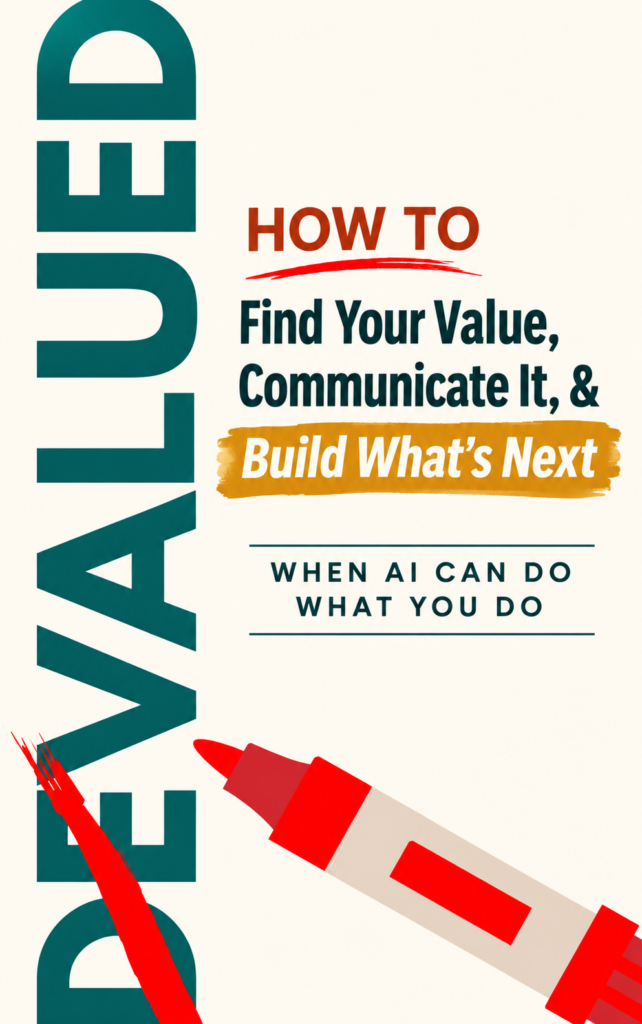
One more thing. I’m writing a short book about the topic of this post — how to find the value in your work that depends on YOU being there. Finding it is only half the job, though. The other half is communicating it so the right people recognize it as what they’ve been looking for.
The book is called DEVALUED. It’s in the early days of development, and I’ll be building parts of it in public. If you want to follow along, get on the waiting list and you’ll hear about it first!