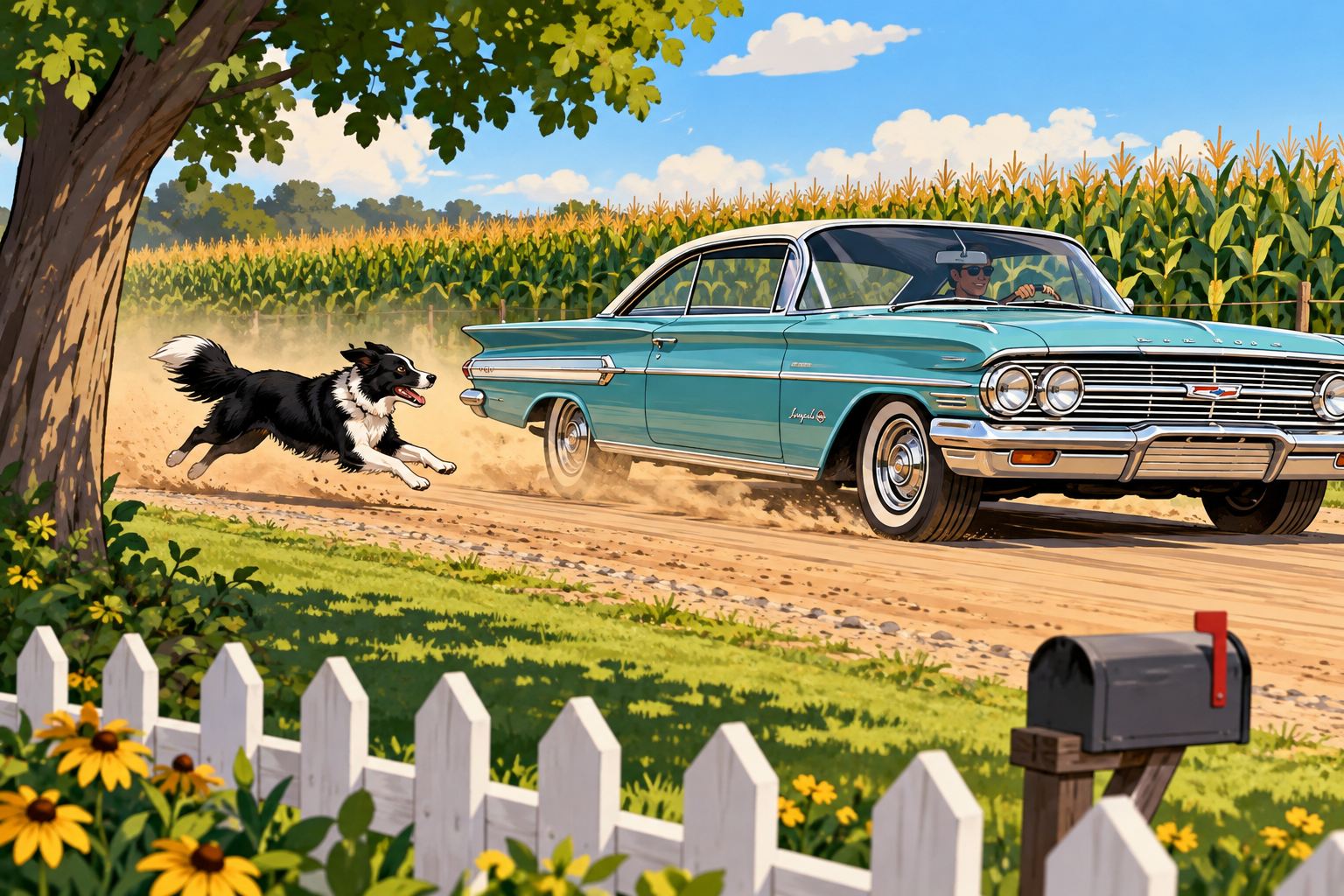
When I was a kid, my grandparents lived on a dirt road. And every time a car came down that road, my grandfather’s Border Collie — Buddy — went after it with everything he had.
Buddy always heard a car coming before any of us did. Ears up. Body low. And then he was off — like he was being shot from a cannon, tearing across the yard and down the road in a cloud of dust, barking at the car’s tires like his life depended on it.
He never caught a single vehicle. Not a car. Not a tractor. Not a pickup truck. Not once. Not even close.
And I never got the sense he was having fun during those frantic chases. It didn’t look like play. It looked like something he couldn’t help. Pure instinct. Every time, he’d come trotting back up the road with his tongue hanging out and his sides heaving, tired and frustrated. Then the next car would come along, and he’d do it all over again.
I’ve been thinking about Buddy quite a bit lately.
Because I think what he did with the cars is what a lot of us have been doing with AI.
A new model drops, and we take off after it. Learn the new tool. Work faster. Upskill. Try to keep pace. We didn’t consciously decide to enter this race. But we did. Because, like Buddy chasing cars, chasing AI is something many of us do by instinct.
And, for a while, it seemed like we might keep pace. Early AI made up sources, wrote generic copy, and got things confidently wrong. If I’m honest, part of me was relieved. If it wasn’t doing things faster or better than we were, maybe nothing really had to change.
But AI isn’t stalling or slowing down. Instead, it’s pushing the pedal to the metal — continuing to go faster and faster while it’s also becoming better and better.
Every few months, AI does something it couldn’t do before. Writing. Analysis. Code. Design. Video. You name it.
These are skills people have spent entire careers learning to do well. For many, their identity and purpose are wrapped up in their ability to be the best at what they do. But, now, it’s becoming harder and harder to do things better or faster than AI.
We’re not going to catch it. And we’re wearing ourselves out trying.
Here’s the thing about Buddy: He wasn’t a clueless dog. Border Collies are some of the smartest, most capable working dogs there are. They’re bred to herd: to read a field, anticipate every move, and keep a group together.
Buddy had a real gift — one that would’ve been deeply valued in the right circumstance. Chasing cars wasn’t it. He should’ve been herding sheep.
I think the same is becoming true of us. Our gifts — whether they be writing, coding, designing, analyzing or anything else — are skills we’ve used to prove our value. But that value proposition is becoming weaker and weaker each time a new AI model or tool rolls out. So, instead of chasing the proverbial AI “car” — which we simply aren’t built to catch — what should we be doing instead?
For Buddy, it was herding sheep. For us? Well, that’s a question worth exploring, isn’t it?
This is NOT a Case of “It’ll All Work Out”
I’m going to be honest with you, because I think you deserve that more than you deserve empty reassurance.
AI can already perform or significantly assist with a growing share of the work people have traditionally been paid for. If you’re a writer, a marketer, an analyst, a designer, a consultant, a programmer, or a teacher, you’ve probably already felt it.
And the questions I’m hearing (and even asking myself) aren’t abstract. They sound like this:
How am I going to support my family and myself?
I’ve spent years building my skills, only to watch AI do the same things, and sometimes do them better. Now what’s left for me?
I’m in college to get a degree. Will there even be a job for me when I graduate?
Why should I trust that anyone is going to step in and fix this?
These aren’t dramatic questions. They’re practical ones. And “follow your purpose” doesn’t answer them. Purpose doesn’t pay the mortgage, the tuition, or the prescription.
So let’s stop thinking that “it’ll all work out.” Maybe it will, eventually, for most people. But “eventually” isn’t a plan or a timeline. “Most people” might or might not include you. And waiting for someone else to rescue us isn’t a plan, either.
We’re Running a Race We Can’t Win. But There’s More to the Story.
For so many of us, competing is instinctive. It’s a very human trait.
But trying to outpace AI on output is a race we’re going to lose. AI doesn’t get tired. It doesn’t need a weekend or a week of vacation. And more and more of the skills we race to master eventually become things AI can either assist with or perform outright.
But that doesn’t have to be the end of the story.
Look at chess. Specifically, look at Deep Blue — the IBM computer that beat the best human player in the world in 1997. Today, no human can beat the top chess engines. And yet chess is arguably more popular now than ever.

People don’t watch grandmasters because they expect them to find a better move than a computer could. Software can identify stronger moves in seconds. We watch because a person is sitting at the board, under pressure, making decisions with limited time and something at stake. We watch another human being calculate, improvise, take risks, make mistakes, recover, and sometimes create something none of us saw coming. There’s an innate beauty in watching people navigate that messiness and imperfection.
Computers becoming better at chess didn’t make human chess worthless. If anything, it revealed a truth that had been there all along: The value of chess was never limited to producing the objectively best move. It was also in watching human beings exercise skill, imagination, judgment, courage, and persistence under real constraints.
The machine changed what counted as scarce. It didn’t eliminate what made us care.
That’s the shift we’re living through. And I think it tells us something important about where we should look for our value next.
Plant Your Flag
While AI doesn’t know what we know in the way we do, it’s becoming VERY good at replicating the outputs others used to depend on us for. Okay. Fine. But it can’t take what we own.
Your Name
When competent — yet often generic — output becomes abundant, reputation begins to matter more. Your name carries a history of what you’ve done, what people expect from you, how you’ve treated others, the quality of the work you’ve put into the world, and whether you’re willing to stand behind it. That history gives people a way to judge something AI-generated output alone can’t tell them: Can I trust the person behind this?
A strong reputation can reduce uncertainty. It can make someone more willing to listen to your recommendation, choose your work, introduce you to someone else, or give you responsibility when the stakes matter. Yes — AI can generate the deliverable — but it doesn’t inherit the reputation you’ve spent years building.
Your Relationships
The people who already know your work, including clients, colleagues, students, collaborators, customers, and communities, know more than what you can do. They know how you think, whether they trust your judgment, whether you understand their context, whether you follow through on promises, and whether you’re willing to stand behind the result. In the past, those qualities were often bundled together with the skill itself and easy to overlook. As AI makes more of the skill-based work easier to replicate, the value inside these relationships shifts toward trust, judgment, accountability, context, and shared history. Those things matter when people are deciding who to listen to, who to work with, who to recommend, and who they’re willing to trust with something that matters.
Your Accountability
Someone still has to own the decision and live with the consequences of the work being done. AI can generate an answer, make a recommendation, or carry out part of the task. But it can also blur the line between who produced the work and who is actually responsible for it. The machine itself doesn’t bear the professional, social, legal, or personal consequences if the judgment turns out to be wrong. As AI takes on more execution, our ability to evaluate the output, make the final call, explain the reasoning behind it, and put our name behind the outcome becomes more important.
Your Judgment
AI is getting better at evaluating options, spotting problems, and even making judgments that once seemed distinctly human. So I don’t think the answer is to assume we’ll always be better judges than the machine.
The harder question is deciding what the judgment should be based on in the first place. What matters most here? Whose needs take priority? What tradeoffs are acceptable? What does “good” mean in this particular situation? And when several reasonable answers exist, which one are you willing to choose?
AI can help weigh the options. It might even see things you don’t. But someone still has to decide which criteria matter, interpret the recommendation in context, and determine whether this is the right choice for these people, at this moment, with these consequences.
Your Story
I’m not talking about storytelling as just a craft. AI can already write stories — and some are pretty amazing. Instead, I’m talking about the experiences that shaped how you see the world: what happened to you, what you tried, what failed, what changed your mind, how it made you feel, what it cost you, and what you learned along the way. Those experiences become part of your judgment and point of view. They help explain why you notice certain things, why you make the decisions you do, and why someone might trust your perspective over a generic answer. It’s your story — no one else’s.
AI can help you shape that story, organize it, or find language for it. But it can’t possess the lived experience behind it. And as information and competent output are becoming abundant with AI, that lived story of yours can become one of the things that makes your work recognizable, credible, and distinctly yours.
These are five places where I’m choosing to plant my flag. Yours might be different. Regardless, find those places and plant your flag.
See It. Claim It. Tell It. Build It.
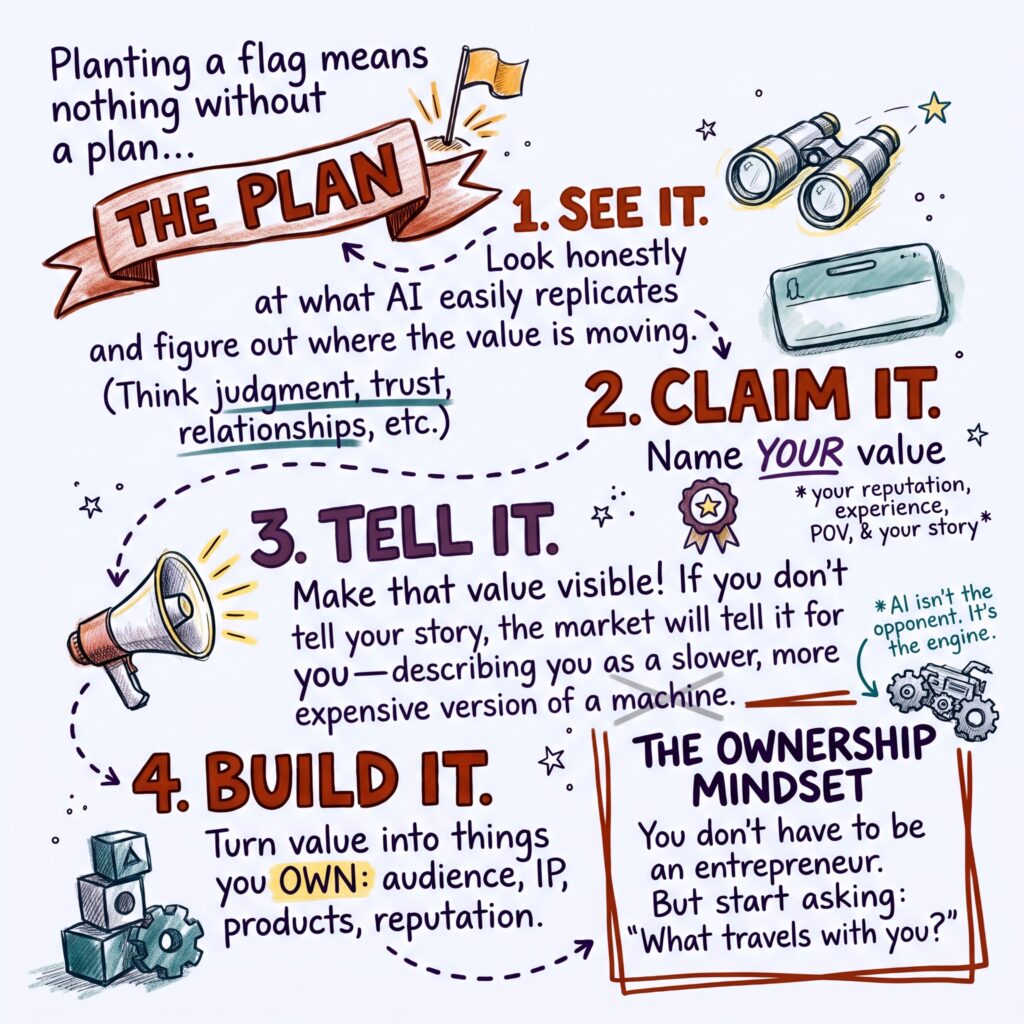
Planting a flag means nothing without a plan. Here’s the one I’m working from.
- See it. Look honestly at which parts of your work are becoming easier, faster, and cheaper for other people to produce with AI. Then look for where the value is moving: judgment, responsibility, trust, relationships, direction, interpretation.
- Claim it. Name the value that remains attached to you: your reputation, relationships, experience, judgment, accountability, point of view, and the story only you have lived.
- Tell it. Make that value visible. Explain it, demonstrate it, teach from it, and tell the stories that make it real. If you don’t tell your story, the market will tell it for you. And it’ll describe you as a slower, more expensive version of a machine.
- Build it. Use AI to turn that value into things you increasingly own: an audience, intellectual property, a product, a body of work, a tool, a practice, a reputation, or an additional source of income. The goal isn’t necessarily to quit your job. It’s to become less dependent on any single employer, client, platform, or skill staying valuable forever.
This doesn’t mean everyone needs to quit their job and start a company. Instead, it’s an ownership mindset. You don’t have to become an entrepreneur. But you do need to start asking what you’re building that travels with you if your job changes, the client leaves, the platform disappears, or the skill gets commoditized. What are the assets that you own?
AI isn’t the opponent in any of this. It’s leverage. Use it where it can do the work well, so you can spend more of your energy on the decisions, relationships, responsibilities, and creations where your presence still matters.
Why I’m Changing My Focus
For a long time, my work around AI was anchored in a simple idea: AI Literate. Not AI Dependent.
I don’t think that’s enough anymore.
AI literacy still matters. But knowing how to use AI won’t protect anyone as the tools keep getting easier to use and better at the work itself. AI literacy is becoming table stakes, not differentiation. The question isn’t just whether you know how to use the tools. Instead, it’s about what you’re going to do with them. How are you going to optimize the leverage they give you — and what value will still be attached to you when everyone else has access to the same tools?
This is what I’ll be writing about, teaching about, and building going forward: Practical, honest help for people whose skills are being commoditized and who would rather build than wait.
I’m not writing this from the sidelines. I’m an entrepreneur and a professor. So, a lot of what I’ve spent years getting good at is now being replicated by AI. For example, I’ve spent almost two decades supplementing my teaching income with a busy freelance communications business. Primarily, I was hired to create written content for websites, video scripts, emails, brochures, print ads, branding, etc. And guess what? ALL of these things can be and are being done by AI now. It’s a much faster and significantly cheaper alternative to hiring me as a freelancer. I get it. And so does my bank account.
So, I’m not going to be writing or talking about this from a safe, detached distance. Because, like you, I’m figuring out what to let go of, what still has value, and what I can build (and own) next.
Let the car go by. Plant your flag. And start building on the ground that’s yours.
If you’re ready to stop chasing the car and start building on ground you own, subscribe to Draw Me a Map and join me on this journey. Every week, I’ll share what I’m learning about where human value is moving, what I’m building with AI, and where having a human behind the work matters now — and where it will matter as AI continues moving forward.