
A dear friend once told me a story about taking her young son to a cafeteria for dinner. He stood in line with his tray, completely overwhelmed by the number of choices in front of him.
There were entrees. Sides. Desserts. Drinks. (And, let’s be real, probably some things trying very hard to look like vegetables.)
The line was moving. The pressure to make a decision was reaching the boiling point. And after staring at all of the options for as long as he possibly could, it became too much.
So, in that make-or-break moment, he blurted out, “Pot pie!”
Not because the chicken pot pie entree was necessarily the best option. (Is it ever??)
Not because he had carefully weighed all of his options. (Because, what’s the point?)
He just needed the overwhelm to STOP.
I think about that story a lot right now when I look at the state of AI in education. Because we’re all standing in the cafeteria line facing choice after choice after choice.
There are new AI models.
New tools.
New features.
New policies.
New warnings.
New best practices.
New think pieces.
New predictions.
New “must-use” platforms.
New “AI-proof” assignments.
New claims that everything is about to change.
New claims that nothing important has changed at all.
And the line keeps moving.

For educators, the problem isn’t just that there’s too much information coming at us about AI.
The bigger problem is that we’re expected to make meaningful decisions in the middle of the chaos.
Should I allow students to use AI on this assignment?
Should I redesign the assignment — or, Lord help me, the entire course?
Should I teach prompt writing?
Should I worry about cheating?
Should I worry more about students not learning how to use these tools?
Should I change my syllabus?
Should I ignore all of this until we know exactly what’s what?
At some point, “Pot pie!” starts to feel like a perfectly reasonable response.
Not because we don’t care — but because we’re overloaded and overwhelmed.
At this moment, we don’t need more information or more choices.
What we need is a way to sort through what’s already in front of us. I use a four-question filter to decide whether any new AI tool, model, update, or prediction actually deserves my attention — and I’ll walk you through it below.
There’s a Key Piece Missing in the “AI Overwhelm” Conversation
A LOT of people are talking about AI overwhelm.
And they’re not wrong.
The pace is exhausting.
The updates are relentless.
The advice is contradictory.
The certainty projected by some is suspiciously loud (and annoying, IMO).
But for higher education, the overwhelm has a specific shape.
Unlike business productivity cases, educators aren’t just trying to decide which AI tool might save them twenty minutes.
They’re trying to decide what students need to learn now that many of the traditional measurements of learning are becoming harder to see.
This is a different kind of dilemma.
When a new AI model or tool appears, it doesn’t just raise the question, “Should I try this?”
It raises questions like:
What can this tool now do that my students used to have to do themselves?
What can it still not do well?
What kinds of thinking does it hide?
What kinds of learning might it quietly replace?
This is where many educators are getting stuck. Because the public AI conversation often treats every update and every tool as if it will change everything.
A model gets better at writing or analyzing.
A new tool creates slides.
Another one summarizes videos.
Another one generates quizzes.
Each announcement can feel like a fresh demand.
Pay attention to this.
Rethink your course because of this.
Prepare your students for this.
Do not fall behind on this.

But here’s something to consider: Not every new AI development deserves the same amount of attention in higher ed.
Some developments are genuinely important.
Some are useful but narrow.
Some are impressive demos with limited classroom relevance.
Some are marketing tactics.
Some are solutions in search of a problem.
And some are just another menu item in the cafeteria line.
The challenge is learning how to tell the difference.
A List Isn’t a Map
A list gives you options.
But a map helps you decide which options matter for where you are trying to go.
This distinction matters because higher education doesn’t need more AI noise disguised as helpfulness. Educators don’t need to be handed another overflowing plate of tools, tips, and predictions with the implication that responsible teaching now requires sampling everything.
We need a way to sort.
Not every AI update deserves the same level of attention.
Not every new tool belongs in your course.
Not every confident prediction should change your syllabus
Not every “best practice” makes sense for your students, your discipline, your institution, or your learning goals.
The question is not, “How do I keep up with all of this?”
The better question is: What do I need to pay attention to because it changes the learning experience? This is a much smaller and more useful question. It’s also the beginning of a map that will help us sort out what to watch and what to ignore.
We Don’t Need More Certainty. We Need Better Sorting.

Okay, to be fair, having a certain level of proven certainty about the impact of AI on teaching and learning would be pretty freakin’ awesome.
But it doesn’t exist. Not right now.
One of the reasons AI feels so overwhelming in education is that so many people are speaking with absolute certainty about a future that is still unfolding.
You’ve probably seen claims like:
AI will make traditional essays obsolete.
AI will replace teachers.
AI will destroy critical thinking.
AI will finally fix education.
AI will ruin education.
The confidence with which such proclamations are made can lead us to believe that they’re absolutely true — and that they shouldn’t be questioned or challenged.
Not the case.
This doesn’t mean every prediction is wrong.
Some may point toward real changes.
Some might identify real risks.
But confidence is not the same thing as wisdom.
A confident person can say:“Students who don’t learn how to use AI will be unemployable.”A wise educator asks:“What forms of AI fluency actually matter in this discipline, and how do students build those skills without becoming dependent on the tool?”
Confidence can make a prediction sound inevitable.
But wisdom helps us decide what to do with that prediction.
In higher education, wisdom means knowing when to redesign an assignment, when to wait, when to experiment at a small scale, when to set a boundary, when to ask harder questions, and when to tell students, “This is still emerging, but here’s how we’re going to think about it together.”
This is the kind of discernment educators need right now.
Not because every AI prediction is wrong.Some of them will turn out to be partly (or even entirely) right. But higher education can’t run on prediction alone. We have to make decisions in real classrooms, with real students, inside real disciplines, under real institutional guidelines.
This requires more than certainty or confidence.
It requires the very human trait of judgment.
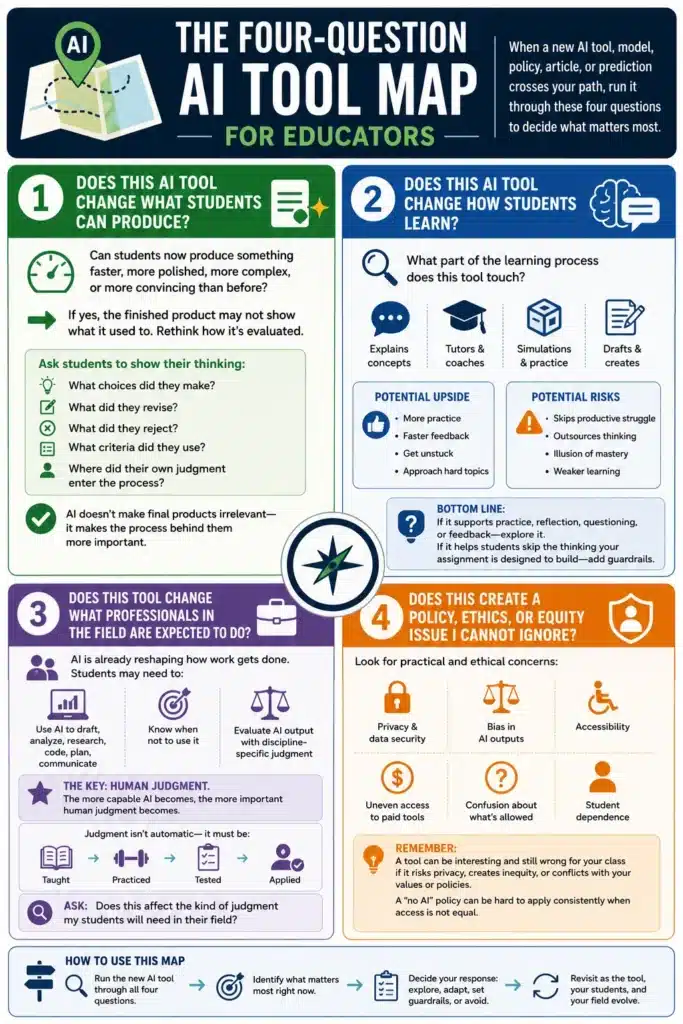
A Four-Question Map for Educators
When a new AI tool, model, policy, article, or prediction crosses your path, you don’t have to decide immediately whether it matters.
Instead, you can run it through a four-question map. Here’s what that looks like:
1. Does this AI tool change what students can produce?
This is the first question because it gets to the visible surface of teaching.
Can students now produce something faster, more polished, more complex, or more convincing than they could before?
This matters for assignments that rely heavily on the finished product as evidence of learning.
If a student can now generate a competent summary, discussion post, slide deck, code sample, literature review, design mockup, or first draft with minimal effort, then the assignment might need a closer look — particularly in how it’s evaluated.
Why?
Because the finished product completed with the new AI tool might not tell you what it used to tell you. (Like, whether a student truly understands a concept you’re trying to teach them.)
This doesn’t mean we abandon the assignment.
It means we might need to ask students to show more of the thinking behind their deliverables.
This can include requiring them to provide information about the following:
• What choices did they make?
• What did they revise?
• What did they reject?
• What criteria did they use?
• Where did their own judgment enter the process?
AI doesn’t make students’ final products irrelevant. But it does make the process behind what they produce more important.
2. Does this AI tool change how students learn?
Some AI tools do more than help students produce work. They shape how students encounter and engage with material.
A chatbot that explains difficult concepts is different from a tool that writes a paragraph or an entire paper.
An AI tutor is different from a citation generator.
A simulation tool is different from an essay assistant.
A model that can hold a long, adaptive conversation might change how students practice, rehearse, question, or receive feedback.
This could be valuable. It could also create problems if students outsource the hard work of thinking and learning to the AI tool too early.
Learning often requires friction. Not pointless friction, but productive friction — the kind that forces students to retrieve knowledge, compare ideas, make decisions, test assumptions, and sit with uncertainty long enough to determine what they do and don’t understand.
If an AI tool removes all of that too quickly, it might create the illusion of mastery while quietly weakening the actual learning. But if used well, the same tool might help students practice more often, get unstuck faster, or approach a difficult topic they might otherwise avoid.
So the question is not simply, “Does this AI tool help?”
The question is:
What part of the learning process does this tool touch?
If it supports practice, reflection, questioning, or feedback, it might be worth exploring.
If it mainly helps students skip the thinking that the assignment was designed to develop, it needs stronger guardrails.
3. Does this tool change what professionals in the field are expected to do?
Higher education doesn’t exist only to preserve traditional assignments.
We’re also preparing students to enter fields that are already being reshaped by AI.
In some fields, students might need to understand how to use AI to draft, analyze, summarize, visualize, code, plan, research, or communicate.
In other fields, they might need to understand when not to use it.
In almost every field, they’ll need to evaluate AI output with discipline-specific judgment.
This last part matters — a LOT.
AI literacy can’t and shouldn’t be separated from subject-matter knowledge and expertise.
A student who doesn’t understand good writing can’t reliably evaluate AI-generated writing.
A student who doesn’t understand research methods can’t reliably evaluate an AI-generated summary of research.
A student who doesn’t understand law, design, accounting, nursing, engineering, journalism, education, or communication can’t reliably tell when an AI output is plausible but wrong.
This is one of the strongest arguments for the continued value of higher education.
The more capable AI becomes, the more important human judgment becomes.
But judgment doesn’t appear automatically. It has to be taught, practiced, and tested.
So when you encounter a new AI development, ask:
Does this affect the kind of judgment my students will need in their field?
If the answer is yes, it deserves attention.
Maybe not a full course redesign.
Maybe not a new unit.
But attention.
4. Does this create a policy, ethics, or equity issue I cannot ignore?
Some AI updates and tools matter because they create practical or ethical concerns, including.
• Privacy & data security
• Bias in AI outputs
• Accessibility
• Uneven access to paid tools
• Confusion about what’s allowed
• Student dependence
These aren’t the kinds of concerns that frequently show up in a ‘Top AI tools for Professors’ roundup. But they matter.
An AI tool can be genuinely interesting and still wrong for your class if it requires students to create accounts, hand over personal data, or pay for the features that actually make it useful.
And a course policy that says ‘no AI’ may be clear on paper, but nearly impossible to apply consistently when students have wildly different levels of access to begin with.
The Bottom Line
The Four-Question Map shows us why educators need more than tool recommendations.
We need decision frameworks.
A tool can be impressive and still not belong in your course.
A model can be powerful and still not be necessary for your students.
A new feature can be interesting and still not be worth changing your assignment this week.
This isn’t resistance to AI.
It’s discernment — and judgment.
(If you prefer a visual of the map, here ya go!)
It’s Not About Keeping Up. It’s About Staying Oriented.
Trying to “keep up” with AI is a losing strategy.

There will always be another update. Another benchmark. Another launch. Another thread. Another webinar. Another urgent claim that “education will never be the same.”
Keeping up implies that there is a finish line.
There’s not one.
But staying oriented is different from acting based on the fear of missing out (or FOMO, for the cool kids in the back).
Orientation requires us to ask:
- What matters for my students?
- What matters for my discipline?
- What decisions are mine to make?
- What can I try at a small, low-risk scale?
- What should I leave alone for now?
Trying to keep up with every AI development can push educators into reaction mode — feeling pressured to respond to every new tool, every confident prediction, every student workaround, and every headline about the future of work.
Orientation gives us permission to say:
I don’t need to know everything before I make a thoughtful decision.
I don’t need to redesign the whole course because one tool improved.
I don’t need to dismiss AI to protect learning.
I don’t need to adopt AI everywhere to prove I am paying attention.
I might be moving carefully — but I’m still moving.
And of course, students are standing in the same cafeteria line — hearing contradictory messages about AI from every direction while trying to pass classes, choose majors, and figure out who they are becoming. Helping them develop judgment, not just rules, is a whole map of its own. And it’s one I’ll save for another article.
What to Do Next
Instead of reading more about AI, try using the sorting filter on something you’ve already been handed.
Maybe it’s a new AI tool a colleague told you about or a new AI platform that a student asked about.
Run it through all four questions.
What changes for student production?
What changes for student learning?
What changes for your field?
What ethical or equity concerns does it raise?
Most things won’t survive all four questions — and that’s the point. The filter isn’t designed to let everything in. It’s designed to help you decide what actually deserves your time and attention.
You don’t need to become an expert on every model. You don’t need to redesign your entire course because someone on LinkedIn sounded very certain before breakfast.
You need a way to make the next decision about AI more clearly.
That’s the map. Not a prediction. Not a perfect policy. Not a universal answer.
It’s a way to stand in front of too many choices and resist the urge to grab the nearest option just to make the discomfort stop.
Sometimes the answer really might be “pot pie.”
But, if it is, it should be because you chose it — not because the line was moving too quickly and the overwhelm was too much.
This entire post comes down to one idea: judgment can’t be outsourced to AI because judgment requires knowing what AI gets wrong. Download my free “Start with What AI Can’t Do” lesson plan that teaches students this concept from the inside out. They prompt AI on something they know deeply, evaluate what it misses, and walk away understanding exactly why their education still matters.
GIF Credits