I spent much of past academic year building the kind of GPTs I thought students would find most useful.
What did they look like?
They were big, comprehensive course coaches.
I designed one “coaching” GPT per class. The idea was that it would be one place students to go for brainstorming, feedback, study support, assignment questions, concept review, etc. when they were working on homework or projects at 3 a.m.
I built them for classes in branding, strategic writing, media law, and digital content. Each one had a name, a role, and a growing set of instructions about what it should and should not do.
Also, they were SUPER cute, if I do say so myself. I created:
- Coach Hoot
- Coach Quill
- Coach Clever
- Coach Sparky
Here’s the lineup:

And they worked — for the most part.
In my branding and writing courses, students did use the coaches.
They asked questions.
They got feedback.
They used them to think through assignments when I wasn’t available, including at hours when no human instructor (or any human being) should reasonably be expected to answer email.
I still believe there’s value in custom GPT course coaches. (I’ve written before about why I wanted students to have access to a course coach at 3 a.m., when I was very much asleep. That need has not gone away.)
But another pattern emerged, too.
The more students used the broad course coaches, the more guardrails I had to add.
I kept refining the instructions.
Tightening the boundaries.
Clarifying what the GPT could help with and what it should NOT help with.
The tool was useful, but it was also sprawling.
And in some classes, especially the ones where the course coach was available but not tied to a specific assignment or recurring workflow, students barely used it at all.
Meanwhile, the GPTs I created as one-offs — the persona-based ones built for a single assignment, a single problem, or even a single conversation — were the ones students seemed to understand (and use) immediately.
I built them to play roles such as:
A skeptical client.
A demanding editor.
A brand strategist with strong opinions.
A stakeholder who needed convincing.
Students would go 10, 15, 20 turns deep with these because the reason they were being asked to use them was clear from the start.
They weren’t staring at an open-ended course coach.
Instead, they were stepping into a narrowly defined simulation.
The pattern took me a while to see, partly because it ran against what I’d assumed.
I thought breadth meant utility.
More capability, more help, more value.
(SPOILER ALERT: It didn’t.)
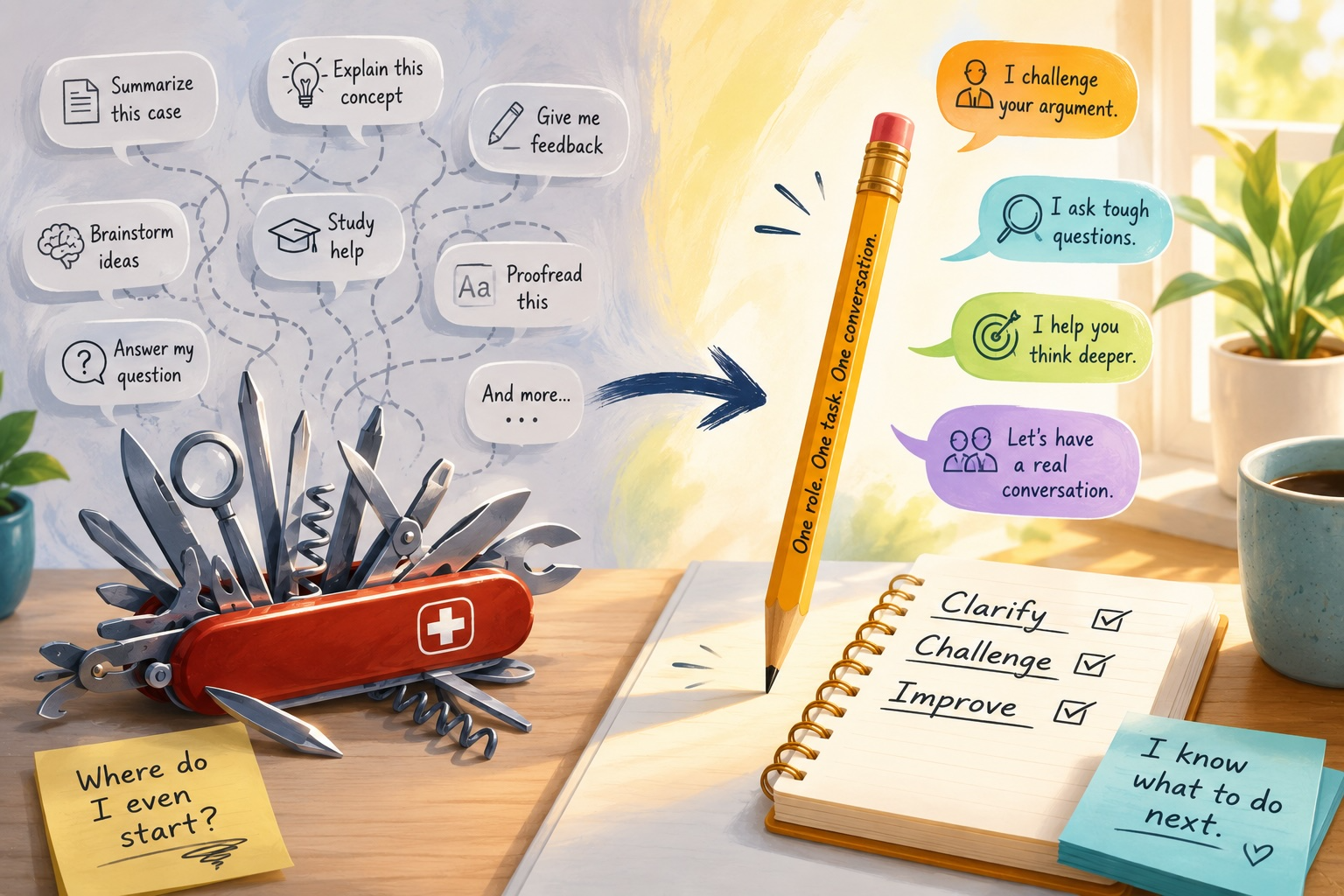
What I was actually building was a tool that asked students to do the hard work of figuring out what to ask it for. The course coach could help with anything, which in practice meant students didn’t quite know where to start.
The narrow GPTs solved that problem by removing the first layer of choice.
For example, a buyer persona GPT showed up with a point of view, a job to do, and stakes. Students didn’t need to figure out how to use it. They just had to engage with it.
By smaller GPTs, I don’t mean I was building less capable ones. Instead, I was simply narrowing their purpose: one role, one task, one learning situation.
And that might be exactly why these smaller GPTs worked better.

GIF Credit: Tenor.com
What I Think Is ACTUALLY Going On
The issue isn’t that broad course coaches are useless. They can be genuinely helpful, especially when students already know what they need.
A student who wants to review an assignment, check whether they are on the right track, ask for study support, or get unstuck after normal class hours may benefit from a broad course coach. That kind of always-available support still matters.
But a broad coach asks something of the student before the interaction even begins.
The student has to decide what they want from it.
That decision is its own cognitive load, and it lands at exactly the moment when the student may already feel uncertain. Otherwise, they probably wouldn’t be reaching for help.
With a narrow-purpose GPT, this first decision has already been made for them because it has a clearly defined role:
It’s a sparring partner.
A difficult client.
A skeptical editor.
Opposing counsel.
The student doesn’t have to figure out what the GPT is for. The purpose is clear.
That matters because the first job of a learning tool is not to impress students with everything it can do. The first job is to make the next move easy to see.
A course coach says: Ask me anything.
A single-purpose GPT says: Defend your idea. Clarify your message. Persuade this client. Anticipate this objection. Revise this argument.
This is a much clearer and actionable invitation.
It also creates a more useful kind of friction. A persona GPT gives the student something to respond to. There’s resistance. There’s a person to persuade, a concern to address, a standard to meet, or an argument to survive.
That friction matters because students are not just passively receiving information from the tool. They’re practicing a kind of thinking.
The smaller GPT creates the scene.
The student steps into it.
The learning happens in the exchange.
Why Smaller GPTs are Easier to Build (Well)

The narrower the role, the more precisely I can design a custom GPT.
I can write a sharper prompt for “opposing counsel in a defamation case” than for “helpful coach for a 15-week law course.”
I can test it against three or four scenarios and know whether it is working.
Does it push back in the right way?
Does it stay in role?
Does it ask the student to clarify weak claims?
Does it challenge unsupported assumptions?
Does it make the student think harder without simply handing over the answer?
That kind of testing is manageable because the tool has a clear job.
The course coach, by contrast, was always harder to finalize because I could never quite finish defining what it was for. Was it a tutor? A writing coach? A study guide? A brainstorming partner? A feedback tool? A policy explainer? A friendly substitute for office hours?
The answer was “yes.” To ALL of it.
And that was part of the problem.
A tool that tries to be everything has to be designed for too many situations at once. It may be impressive in theory, but harder to explain, harder to test, and harder for students to know how to use.
Smaller GPTs aren’t just easier for students to enter — they’re easier for instructors to improve.
My Newest Experiment: An Opposing Counsel GPT

I’m building a GPT now for my Media Law class that plays opposing counsel.
Its only job is to push back.
It does not help students brainstorm topics. It does not summarize cases. It does not explain doctrines. It does not polish their writing.
It argues against them.
If a student makes a claim, it challenges the claim.
If a student relies on weak evidence, it presses for stronger support.
If a student overlooks the other side’s argument, it brings that argument forward.
If a student sounds too confident, it makes them earn that confidence.
That’s the GPT’s whole job.
And while I haven’t finished testing it yet, I suspect students will use it more than any course coach I’ve built because they’ll know exactly what to do with it.
They won’t have to ask, “How can this help me?”
The answer will be obvious: make your argument and see if it survives.
4 Things Worth Trying
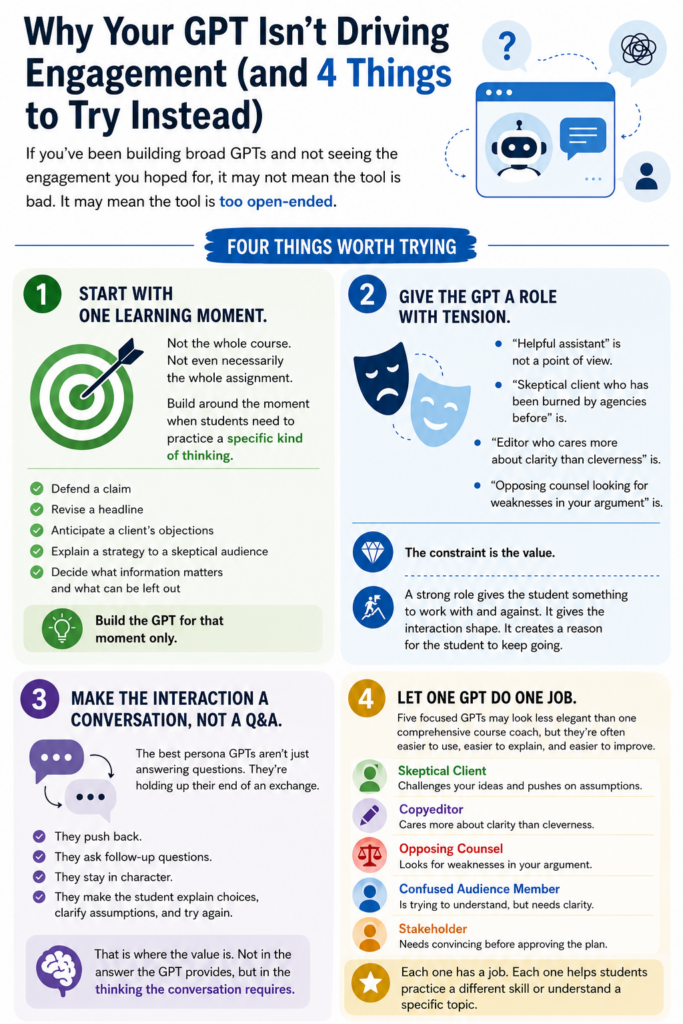
If you’ve been building broad GPTs and not seeing the engagement you hoped for, it may not mean the tool is bad. It may mean the tool is too open-ended.
Here are four things worth trying.
1. Start with one learning moment.
Not the whole course. Not even necessarily the whole assignment.
Build around the moment when students need to practice a specific kind of thinking.
Maybe they need to defend a claim. Maybe they need to revise a headline. Maybe they need to anticipate a client’s objections. Maybe they need to explain a strategy to someone who is skeptical. Maybe they need to decide what information matters and what can be left out.
Build the GPT for that moment only.
2. Give the GPT a role with tension.
“Helpful assistant” is not a point of view.
“Skeptical client who has been burned by agencies before” is.
“Editor who cares more about clarity than cleverness” is.
“Opposing counsel looking for weaknesses in your argument” is.
The constraint is the value.
A strong role gives the student something to work with and against. It gives the interaction shape. It creates a reason for the student to keep going.
3. Make the interaction a conversation, not a Q&A.
The best persona GPTs aren’t just answering questions. They’re holding up their end of an exchange.
They push back.
They ask follow-up questions.
They stay in character.
They make the student explain choices, clarify assumptions, and try again.
That is where the value is. Not in the answer the GPT provides, but in the thinking the conversation requires.
4. Let one GPT do one job.
Five focused GPTs may look less elegant than one comprehensive course coach, but they’re often easier to use, easier to explain, and easier to improve.
One GPT can be the skeptical client.
One can be the copyeditor.
One can be the opposing counsel.
One can be the audience member who is confused but trying to understand.
One can be the stakeholder who needs convincing before approving the plan.
Each one has a job. Each one helps students practice a different skill or understand a specific topic.
In my opinion, this is more useful than asking one tool to do five things adequately.
The Bigger Lesson

I’m not giving up course coaches.
There is still a place for a tool that can range across a whole semester. A broad course coach can help students review concepts, revisit assignment instructions, ask general questions, or get unstuck when they are working outside normal class hours.
But I no longer think broad course coaches should always be my first move.
I’m starting narrower now.
One assignment.
One role.
One conversation.
One learning moment.
Not because smaller GPTs are less ambitious, and not because broad coaches have no value.
Because smaller GPTs make the learning easier to enter.
That might be the part I missed when I first started building custom GPTs.
I was thinking about what the tool could do.
Students were responding to what the tool invited them to do. And that was pretty unclear at times.
This distinction matters.
Because in teaching, the goal is not to build the most capable tool. The goal is to build the tool that helps students practice the thing they actually need to practice.
It turns out students don’t always need a Swiss Army knife.
Sometimes they just need a screwdriver.