The first day of class is something I’ve looked forward to since I was a wee lass in elementary school.
I was the kid who BEGGED her parents to take her to Kmart and/or Woolworth’s and/or Eckerd Drugstore to buy back-to-school supplies at LEAST three weeks in advance. I mean, it takes time to get your new book bag, notebooks, pencil box and lunchbox organized and ready to go.
As a professor, that love for the first day of classes has been there for me at the beginning of the fall semester for almost 20 years.
But not this year. Nope. No love in sight.
There was plenty of dread, though. And worry, concern, uncertainty — you name it.
Why?
As hard as this is for me to admit, I place much of the blame on the growing impact AI is having on education. And it ain’t good.
Educators are on the Frontline
There’s a lot of chatter these days about how AI is impacting various industries. Corporate prognosticators love to talk about five-year plans and productivity metrics. But — in many cases — they’re future-casting. While I love that feature in a weather app, I don’t care for it when it comes to predicting what might or might not happen to the human condition.
For those of us in education, the disruption of AI isn’t a future possibility. We don’t have the luxury of “gaming it out.” It’s happening in real time, right now, in classrooms everywhere and at every level.
And there’s no consensus about what to do.
Some educators, understandably so, feel like throwing up their hands in surrender, saying, “What’s the fucking point??”
Others feel a deep sense of mourning. They went into higher education because they love to teach — and they’re GREAT at it. But the growing presence of AI both inside and outside of the classroom is quickly chipping away at their passion
And many are dazed and confused. AI is causing such vast and rapid changes in education that it feels like being on a treadmill in a version of Dante’s nine circles of Hell.
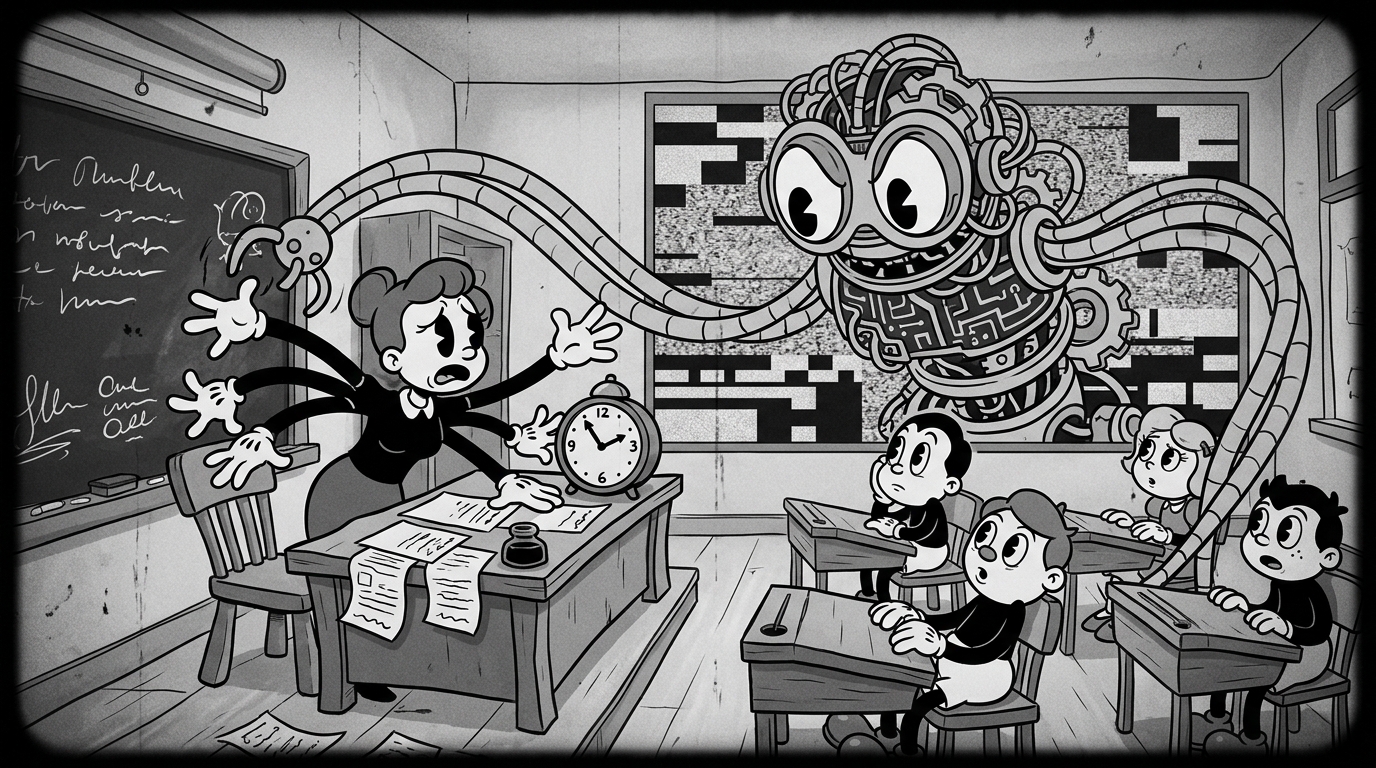
If you dare to peer into that hell, you’ll see that the chaos stemming from AI isn’t isolated to a single department or a single institution. Instead, it’s tearing through the entire educational ecosystem like a bull in a china shop.
From where I sit, three primary groups grapple daily with the impact of AI in education. Here they are:
Faculty: Reluctant Detectives
“AI detection” has become quite the focus in education recently. And, frankly, it makes me feel a bit queasy.
First, as of this writing, I’m not aware of any AI detection tool that’s 100% right 100% of the time. That, in my opinion, makes them relatively useless for educators. The last thing I want is to accuse a student of cheating based on one questionable data point. The detection tools will improve over time. But, for now, I don’t use them.
Second, I didn’t go into education to be a police officer or detective. If I had wanted to be either of those, I’d have gone into law enforcement. (Or, as a fan of Magnum, P.I., I might have become a private investigator in Hawaii.)

I don’t spend every waking hour playing forensic detective with assignments students submit. But the constant background hum of “is this actually theirs?” is exhausting in a way that’s hard to describe. Suffice it to say, I absolutely HATE it. And I also hate the way it’s changing how I show up with and for my students.
Here’s what I mean:
For the first time in a decade, I opened this semester by walking students through my syllabus in an annoying level of detail.
Usually, I have some fun, course-related activities for students to jump into on the first day of class. It gives them a feel for what a class is going to be like and what I’m going to be like as their professor.
But this academic year, I opened with a syllabus review. The main reason I did it was that the AI policy for my classes needed to be said IN the room, out loud, with everyone hearing the same thing at the same time.
I told them what tech they could use in class — and what they couldn’t.
I told them they’d be required to save every version of their work — every draft, every revision, every messy in-between. That way, if I suspect AI has been used, a student can provide all of the iterations of their work and walk me through their thinking process.
In many unwelcome ways, I feel like I’ve become a hall monitor with a syllabus. I’ve never wanted to be that professor. Yet here I am.
Some people might argue — some people actually do — “If a student wants to use AI to skip the learning, so what? It’s their (or their parents’) tuition.” That’s fair, BUT — I didn’t get into this profession to watch a machine do the thinking for my students. So, I don’t have the luxury of shrugging and saying, “Fuck it.”
Faculty are learning how to design assignments defensively. We tweak discussion forum questions. We add multi-stage check-ins. We build in oral components just to make sure actual learning is happening. And when the math on a submission doesn’t add up, we get pulled into not-so-fun conversations we never wanted to have. It sucks when you’re sitting across from a student in your office, questioning the basic authorship of their assignment.
This is the tax faculty are paying. It drains the energy we’d rather spend on the stuff we actually love — the inspiration, the mentorship, the moment a concept lands.
Students: Learning in a World That’s Increasingly Unfair
For students, AI has created a kind of psychological friction that they didn’t have to navigate just a few years ago. When a chatbot can spit out an essay or solve a math problem in three seconds, the temptation to use it is loud. Really loud.
Here’s what people miss, though: Most students aren’t using AI to cheat out of malice. They’re using it out of anxiety.
They look around and assume everyone else is quietly using it. So they use it too — because who wants to be the one kid spending hours grinding through the assignment the hard way while everyone else is done in 20 minutes?
Also, faculty are at different levels in their knowledge about AI and how students are using it. So, in some cases, students who use AI might get a higher grade on an assignment than the student who actually put in the hard work — simply because the faculty member’s AI radar didn’t trigger the need to validate authenticity. Again, it’s no one’s fault. But it’s also a really crappy thing for the student who’s trying so hard to actually learn.
That’s the arms race. And students know — they KNOW — it’s making their own thinking softer. But the path of least resistance is loud, and their own critical-thinking muscle is pretty damn quiet. (Brain development and all. Remember that we’re talking about young adults who are typically 18 to 21 years old.)
I don’t blame them. I really don’t. But I feel a huge weight of responsibility when it comes to actually helping them learn.
Administrators: Struggling to Lead When the Goal Line Keeps Moving
Hovering over all of this is a massive institutional puzzle — one that puts administrators in a bind that’s genuinely brutal.
Think about what leadership is being asked to do right now. Prove the value of the institution. Prove the value of the degree students (and/or their parents) are paying real money to earn. AND simultaneously demonstrate that the institution is embracing AI, leaning into innovation, preparing students for a future nobody can quite see.
Those things pull in opposite directions. Hard.
Lean too far one way, and you look like you’re stuck in the past — refusing to prepare students for the world they’re actually entering after graduation. Lean too far the other way, and you look like you’re waving a white flag on the very thing that makes a degree worth anything: the hard-won proof that a human being learned something.
There’s no cavalry coming — not because anyone’s failing, but because there’s no cavalry TO come. This is genuinely new. Every institution in the country is working it out in real time, and so is every faculty member, every administrator, every student. (I chair my school’s AI Working Committee. We’re constantly looking for potential solutions. But just when you think you might have something figured out…

We’re all figuring this out together. Which can be uncomfortable since everyone is coming at this challenge with different perspectives and different goals. So, the question becomes: Is the fight worth it?
What I’m Actually Fighting For
Here’s the thing: I’m an AI enthusiast. I build with it every week. I’ve built things this year — simulations, agents, whole classroom tools — that I couldn’t have DREAMED of building even a year ago. I love this stuff.
And also — there’s a line I’m not willing to cross.
I don’t want to live in a world where doctors, attorneys, engineers, teachers, or any other professionals haven’t actually learned their profession. I don’t want a doctor who’s operating on someone to have gotten their degree by offloading their thinking to AI. And I sure as HELL don’t want an engineer who doesn’t know how to evaluate AI output to be building the bridges I drive across.
AI can elevate thinking. But the thinking has to already be there.
You can’t accelerate a skill you haven’t built. And there should be no place for AI in the classroom until students can do — on their own, from scratch, with their own brains — the very things they ask AI to do for them. Until they can prove they can, the machine stays off.
That’s the ground I’m standing on this semester. It’s harder to stand on than it used to be. But I’m standing on it.
So, yes, this semester started with the hardest first day of class I’ve ever had to face. But I’m still going to walk into those classrooms and keep fighting for the human minds sitting in front of me.
They deserve to learn how to think.
Yours in the fight — even on days when it seems hopeless,
Michele
P.S. Here’s a question for all of my fellow educators: What’s one thing AI has caused you to change about your teaching this fall that came as a complete surprise to you? Tell me. I want (okay, need) to hear it!