
This summer I taught two courses — both of which were online and fully asynchronous.
So, wasn’t standing in front of my students in a classroom.
There weren’t any opportunities to “read the room”, so to speak.
And I didn’t have students coming up to me after class with questions or to just let me know they enjoyed something we did in class that day.
Instead, it was just me, our university’s learning management system (LMS), and students in full summer mode—doing internships, working part-time jobs, and traveling to places with much better views than my video lectures.
As I began prepping for these classes in late May, the question I kept circling was this:
How do I keep students engaged with content they genuinely need to learn when we won’t be sharing the same space two or three times a week?
I know the standard answers.
More discussion boards.
Video lectures with embedded quiz questions.
Weekly check-in emails with just the right amount of exclamation points.
I’ve done all of it. Over and over and over again.
And about the only thing these efforts accomplish is this: compliance.
Students complete things. But completion isn’t the same as thinking, understanding and learning.
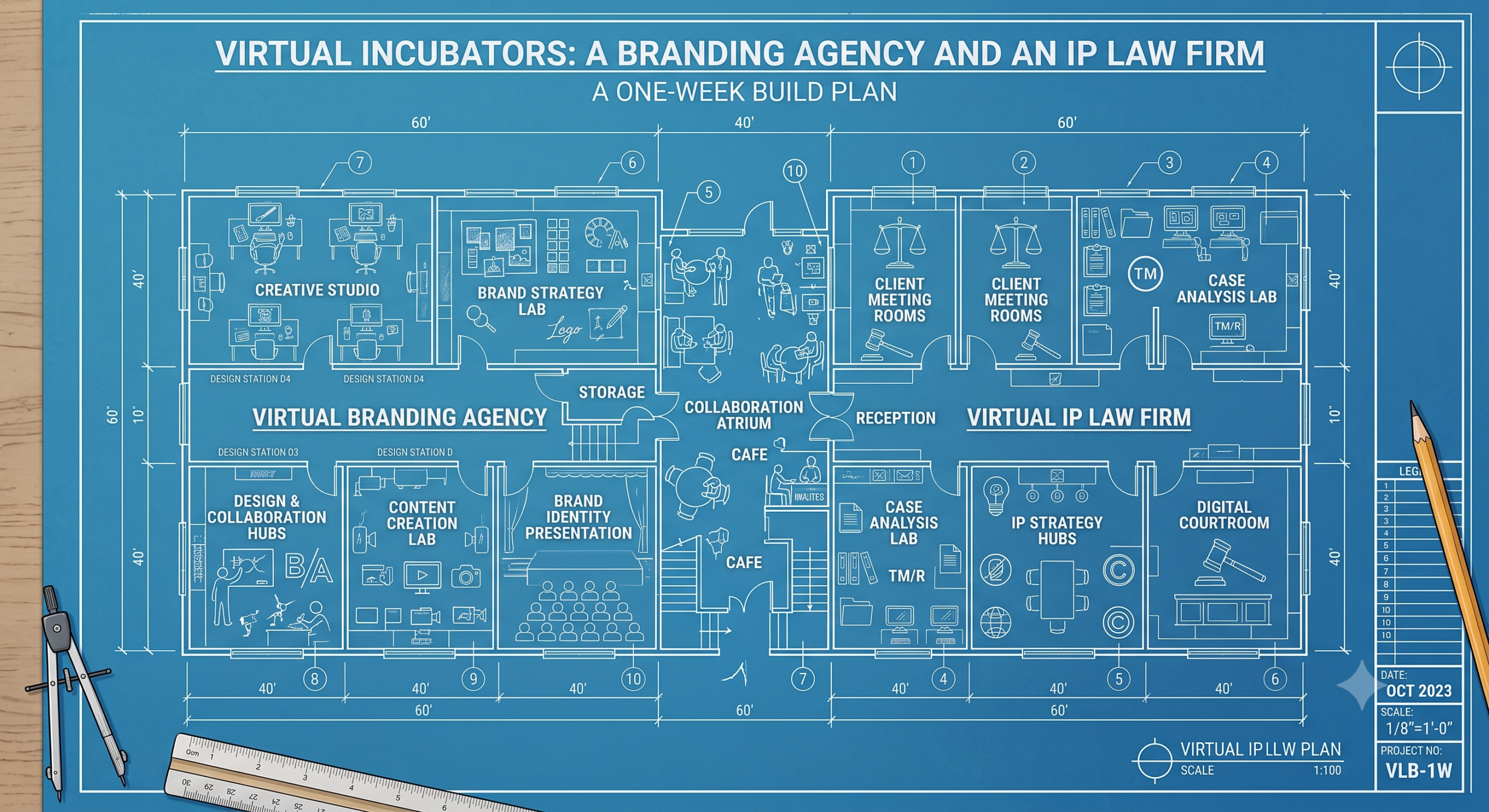
So this summer I tried something different: Worldbuilding with AI
I gave my students in both courses somewhere to be.
For my Media Law students, I built a law firm.
And for my Brand Identity students, I built a branding agency.
Both were completed in less than a week.
The Problem with “Engagement”
Here’s the thing about asynchronous courses that took me longer to realize than it should have:
The engagement problem isn’t a content problem.
For example, the materials I create to teach fair use in Media Law aren’t boring. (Okay, maybe a little boring. Copyright law isn’t exactly a thriller.)
The problem in asynchronous courses is structural.
In a classroom, there’s an expectation of engagement. Students are compelled to think out loud because there’s a person across from them expecting a response. Sometimes it’s a professor. Sometimes it’s another student. And sometimes it’s a guest speaker.
Asynchronous courses are more like swimming alone in the ocean.

Students are surrounded by content, with grades, questions, and accountability lurking somewhere beneath the surface. It can feel very disconcerting not having someone physically there to bring them back to shore.
Discussion boards try to simulate the back-and-forth exchange that happens in the classroom. But I question their effectiveness. The students know nobody’s really across the table (other than me when I’m grading their response). Instead, they’re posting into the void and replying to three classmates because the rubric says so.
What I wanted was the thing a discussion board can’t give: a conversation partner who pushes back. One who’s available at 11 p.m. when the student who’s doing an internship or working a part-time job by day finally has a chance to open their laptop in the evening and work on the week’s assignments. And one who never gets tired of asking, “But why do you think that factor helps your client’s case?” Or, “Does your unique selling proposition really distinguish your business from competitors?”
This is a role AI can actually play — if you design the role carefully.
BUILD ONE: The Law Firm
For my Media Law students, I built The IP Associate
It was a web-based simulation that casts each student as a first-year associate at a fictional intellectual property law firm.
Here’s what the experience looked like from the students’ perspective:
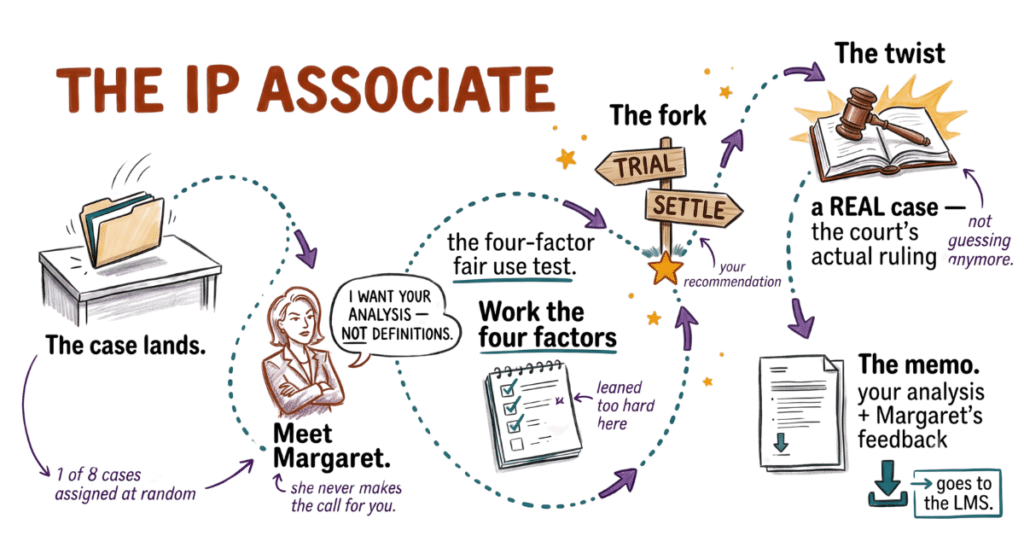
You show up as a first-year associate at an intellectual property law firm.
Day one, a case lands on your desk. It’s one of eight hypotheticals, assigned at random, with a client whose problem is now yours to solve.
And your boss is Margaret Smith — a senior partner who wants your analysis, not your memorized definitions of legal terminology.
That one shift changes everything. The work stops feeling like an assignment and starts feeling like a case you’re actually responsible for.
You work it the way a junior associate would. You take the four-factor fair use test and apply each factor to the specific facts of your case — not in the abstract, but to this client, this dispute.
Each factor builds toward one call: Does the client go to trial, or settle?
Margaret doesn’t just wave you through. Nope. You won’t get any coddling from her. Instead, she pushes on your analysis. She asks you to justify it. She points out where your reasoning slipped — which factor you leaned on too hard, which one you didn’t lean on enough.
But she never does the case analysis for you.
Once you’ve analyzed all four factors and revised your reasoning, you make your recommendation regarding whether your client has a strong enough case to go to trial or whether trying to settle with the plaintiff might be the better call.
After submitting your recommendation to Margaret, she drops a twist — revealing a real case, almost identical to yours, with the facts and the court’s actual ruling laid out. You’re seeing how a real court reasoned through the same problem you just worked.
At the end, you download a memo on the firm’s letterhead with your full analysis, Margaret’s feedback, and the recommendation you made. That’s what you upload to the LMS for grading.
BUILD TWO: The Branding Agency
The world I built for my Brand Identity students was a fictional branding agency called Bramwell & Finnegan. In it, the students played the role of entry-level brand strategists.
Here’s what the students’ experience looked like:
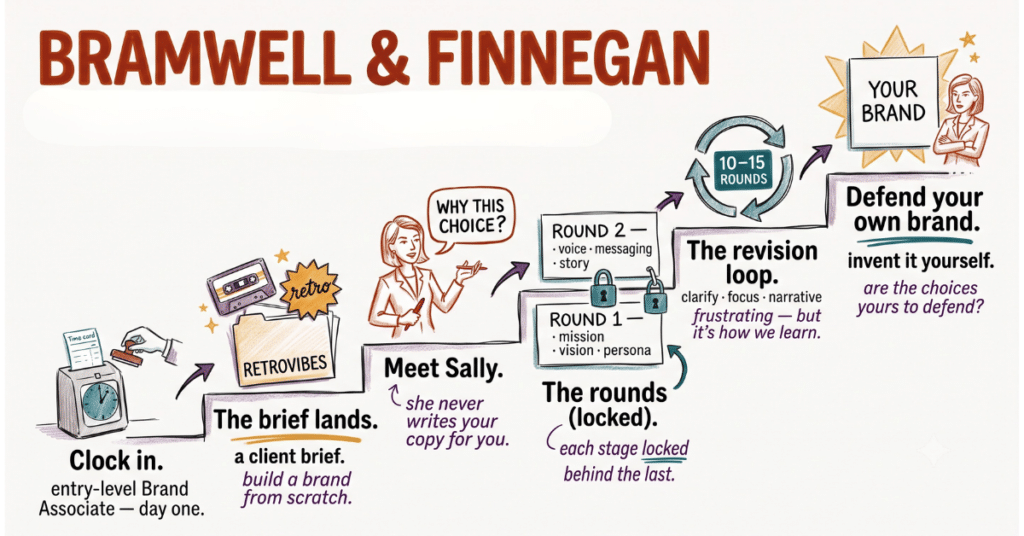
With the Bramwell & Finnegan simulation, you don’t log in to an assignment. You clock in as an entry-level brand associate.
Day one, a client brief lands on your desk. It’s for a nostalgia retailer called RetroVibes, which sells memorabilia from the 80s and 90s. It needs a brand built from scratch.
Your boss is Sally — a creative director who has clearly watched a lot of juniors struggle with learning the ropes of brand strategy. So, she provides feedback for every entry you submit.
But the feedback doesn’t feel like a grade. Instead, it starts feeling like notes from someone who does this branding stuff for a living.
The work comes in rounds, a week at a time. Round One is the foundations — mission, vision, the persona you’re building for. Round Two is voice and messaging and the brand story. Each stage locked behind the last, every decision pulled back into the next conversation.
Nothing stands alone. RetroVibes becomes one thing you’re responsible for — not a pile of disconnected exercises.
And Sally isn’t shy with her opinions. At. All. She asks why. She tells you where things went off the rails — which choice drifted from the brief, which line doesn’t sound like the brand you said you were building.
She never writes your copy for you. It’s your copy. So, it’s your job to write it.
Then, in the final week, the floor drops out. You move on from RetroVibes and are told to invent your own fictional brand — client, category, the whole thing. At this point, Sally stops building alongside you and turns into a focused critic. It’s no longer about following a process someone laid out for you. It’s about whether you can defend the branding choices you make.
So, how are students feeling about Sally? In a recent conversation, a student told me that Sally is really pushing them to work on things like clarification, focus, narrative structure, etc. Sometimes, that means going through multiple rounds of changes before getting Sally’s sign-off. (Some students have gone through 10-15 rounds of changes for a single element.) This is exactly what a real-life creative director would push a junior brand associate to do.
It’s SO frustrating. But it’s how we learn.
They also appreciated being able to apply the concepts we were covering in class to something tangible rather than just reading or hearing about them.
Also, as we moved into the final project, I received requests from students about making Sally available to provide feedback on the work they were doing for that. (Of course, I did!)
How the Builds Were Done
I vibe coded both simulations in Lovable, connected them to my own Anthropic API key, and put Claude to work powering the feedback. That’s what makes Margaret and Sally more than one-dimensional characters. They provide students with substantive responses to their actual analysis, not just a checkmark for submission.
Behind the scenes, each firm runs on the same scaffolding: a grading rubric, student-facing instructions living in Moodle, my teaching materials, and a system prompt I calibrated and recalibrated more times than I’d like to admit. (More on that in a minute.)
The two aren’t identical under the hood — Margaret has to know fair use, Sally has to know branding — but the architecture is the same:
Give the student a role.
Hand them a real problem.
Have a senior voice push on their reasoning and make them justify it.
Then hand them a document with their name on it at the end.
What Vibe Coding the Builds Looked Like
Let me be honest about the title I wrote for this post, because “in a week” makes this sound breezier than it was.
The speed is real. Tools like Lovable have collapsed the distance between “I have an idea” and “I have a working app” in a way that still feels slightly bizarre. I’m not a developer. Five years ago, building this type of project would’ve needed a grant, a dev team, and a timeline measured in months. This summer it needed me, Lovable, six days, and a lot of iteration on my end.
But I didn’t spend that week watching AI produce my vision. I spent it on the unglamorous parts, like:
- Security, so the thing I handed students wasn’t leaking my API key or doing whatever a clever student told it to.
- System prompt calibration, over and over — because feedback that’s too generous teaches nothing, feedback that’s unclear isn’t helpful, and feedback that’s too harsh teaches students to stop trying.
- A rubric so that students would have a clear idea regarding how their work would be evaluated.
- Instructions that tried to anticipate every question a student might have.
The AI built the rooms. I still had to decide what happens inside them.
That’s the whole game: AI handles the construction, the educator handles the learning experience. As they say, “Teamwork makes the dream work.”
Where This Can Go Wrong
These simulations are not a substitute for an in-person classroom experience, and they’ll fail in predictable ways.
Margaret argues tirelessly, but she doesn’t notice when a student is quietly drowning. That’s still my job — and in an asynchronous course, I have to work harder at it, not less.
A simulation can also become a very sophisticated way to perform understanding instead of building it if the feedback loop rewards the wrong things. Which is exactly why calibration mattered more than any other part of the build. (And I calibrated — A LOT!)

Also, if you’re thinking about building something like this, don’t skip the security work. Doing the worldbuilding is the fun part. But some of the more important parts (like security)? Not so much.
The Question Before the Platform
If you’re teaching asynchronously, the takeaway from all of this isn’t “build a law firm” or “build an agency.” Instead, it’s this question:
Where in your course does a student have to defend their thinking to someone who pushes back?
If the answer is nowhere, that’s the gap. But now, we have the technology to close it in a way that requires students to develop and sharpen their critical thinking skills.
The design of the learning experience is still yours. The decision about what to create and for what purpose is still yours. These are the parts of teaching that have always been the actual work. And they still are.
BUILD IT SESSIONS
If you want to create something like this for YOUR course — based on your scenarios, your rubric, your syllabus — that’s what Build It Sessions are for. Click the button below to learn more about them.