
A few days ago, I was talking with someone who works at a large corporation. He mentioned, almost in passing, that he uses AI to help with parts of his job — not to do the work for him, but more like a thinking partner. A second set of eyes. Something to organize his thoughts or get him unstuck when he’s staring at a blank screen.
Then, I asked the obvious follow-up question: Is anyone else in the company using it, too?
“Yes,” he said.
Then he paused.
“They just won’t admit it.”

What he said has stuck with me — and it comes down to this: AI use at work is common. Admitting to it still feels risky.
People are using it to draft the first version of an email. Summarize a long document. Clean up a rough paragraph. Organize meeting notes. Brainstorm before they walk into a room.
But they’re not saying so. Not because they’re doing something wrong, but because they don’t know how others will react.
“Will my manager think I’m lazy?”
“Will my colleagues consider me to be less capable or that I’m cutting corners?”
“Did I just violate an unspoken (and probably unwritten) company AI policy?”
This is the AI taboo problem. It’s the gap between how much people are actually using AI and how safe they feel saying so out loud.
And here’s the part that should worry leaders more than the AI use itself: Silence doesn’t mean less AI use by employees. It means hidden AI use.
This is problematic because you can’t coach judgment you can’t see. You can’t build a realistic policy around an invisible workflow. You won’t know how client data was pasted into an unapproved tool if nobody’s talking about which tools they’re using.
Big Business vs. Small Business
Around the time I spoke with the person working for a large corporation, I also had a conversation about AI use with someone who works for a small business. Her experience sounded almost like the polar opposite of what I’d been hearing from people in larger organizations.
At her company, AI use is encouraged.
There are fewer layers. Less bureaucracy. Less hand-wringing over whether using AI means someone is secretly cutting corners. The attitude is more like: If it saves time, saves money, and helps us get the work done, use it.
And honestly, that tracks with what seems to be happening more broadly.
Small businesses are using AI more than many people probably assume. They may not have enterprise task forces or glossy internal AI strategy decks, but they are experimenting. They’re trying tools and figuring out where AI helps with marketing, customer service, writing, operations, and all the other daily work that small teams have to stretch themselves to cover.
In fact, when it comes to AI usage, the gap between large and small businesses appears to be narrowing. Large companies were ahead early on, but small businesses are catching up faster than some people expected. One SBA report found that small-business AI use rose from 6.3% to 8.8% in the most recent period studied, while large-business adoption had slowed or dipped. The report’s larger point was not that small firms have fully caught up, but that the AI divide may be much smaller than earlier technology gaps, like broadband access.
But here’s the twist: “Using AI” is not the same thing as knowing what to do with it.
A lot of small businesses are still in the wing-it stage. Someone uses ChatGPT to draft a sales email. Someone else uses AI to write product descriptions. A manager tries it for scheduling, planning, or customer follow-up. None of that is necessarily a problem. In fact, some of it may be genuinely useful.
But in many cases, there is no shared understanding of what’s allowed, what’s risky, what needs to be reviewed, or where AI actually fits into the business. One small-business AI guide put it plainly: Plenty of small businesses are using AI, but many are still trying to move from casual use into intentional adoption.
So the small-business version of the AI taboo problem isn’t always, “I’m afraid I’ll get in trouble for using AI.”
Sometimes it is more like: “Everybody sort of knows people are using it, but nobody has really said what counts as smart use, sloppy use, or crossing a line.”
Large companies have a different version of the same mess.
They aren’t ignoring AI. They’re surrounded by it. They have tools, pilots, agents, vendors, strategies, committees, policies, and probably at least one very serious slide deck with the word “transformation” in 48-point font.
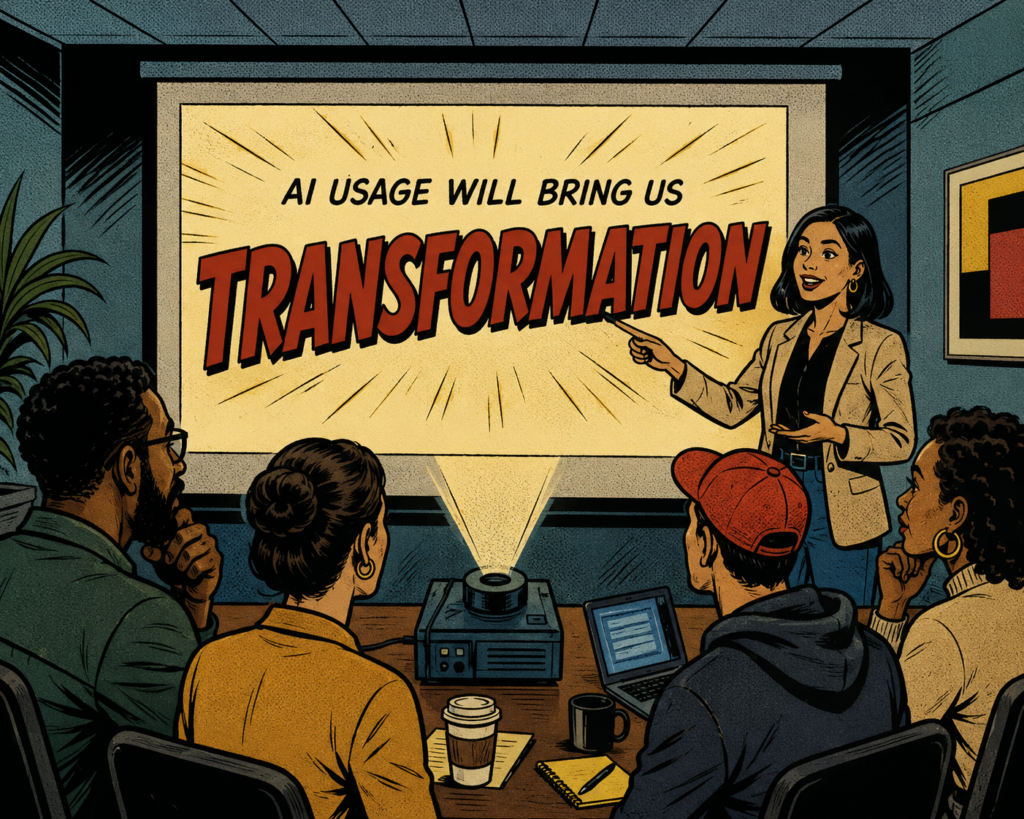
But that does not mean they have clarity around how, if and when AI is being integrated into their company.
WRITER’s 2026 enterprise AI survey found that 79% of organizations are facing AI adoption challenges, even though 59% are investing more than $1 million a year in AI technology. The same report found that 75% of executives admit their AI strategy is “more for show” than real guidance, and 67% believe their company has already had a data leak or breach because of unapproved AI tools.
This is the enterprise version of the AI taboo problem: Lots of official activity, but still plenty of uncertainty about what people are actually doing, which tools they are using, whether the work can be trusted, and who’s responsible when something goes wrong.
So, no, this isn’t just a big-company problem.
Small businesses may be moving quickly, but often without much structure.
Large businesses may have more structure, but often without much trust or coherence.
Different scales. Same underlying issue.
People are using AI at work. The question is whether they feel safe enough, clear enough, and supported enough to talk honestly about how.
So, What Can We Do?
Let me go ahead and admit that there’s no universal fix here — at least not that I’ve come up with yet.
Company size, industry, culture, and risk tolerance all shape what a “good” AI policy or workflow looks like. A 15-person marketing agency and a 3,000-person financial services firm aren’t going to solve this the same way — and they shouldn’t try.
That can’t become an excuse for inaction, though. As they say, “Perfection can’t be the enemy of the good.”
So, to get the conversation started, here are starting points that can be applied almost anywhere:
If AI use is off the table, say so — clearly.
Don’t do this in a policy document buried in a shared drive. Instead, say it out loud, in plain language, with specific examples of what’s prohibited and why. Employees who don’t know the rules can’t follow them. And if they’re already using AI and didn’t know they weren’t supposed to, you have a communication problem, not a misconduct problem.
If some use is acceptable, define what “some” means.
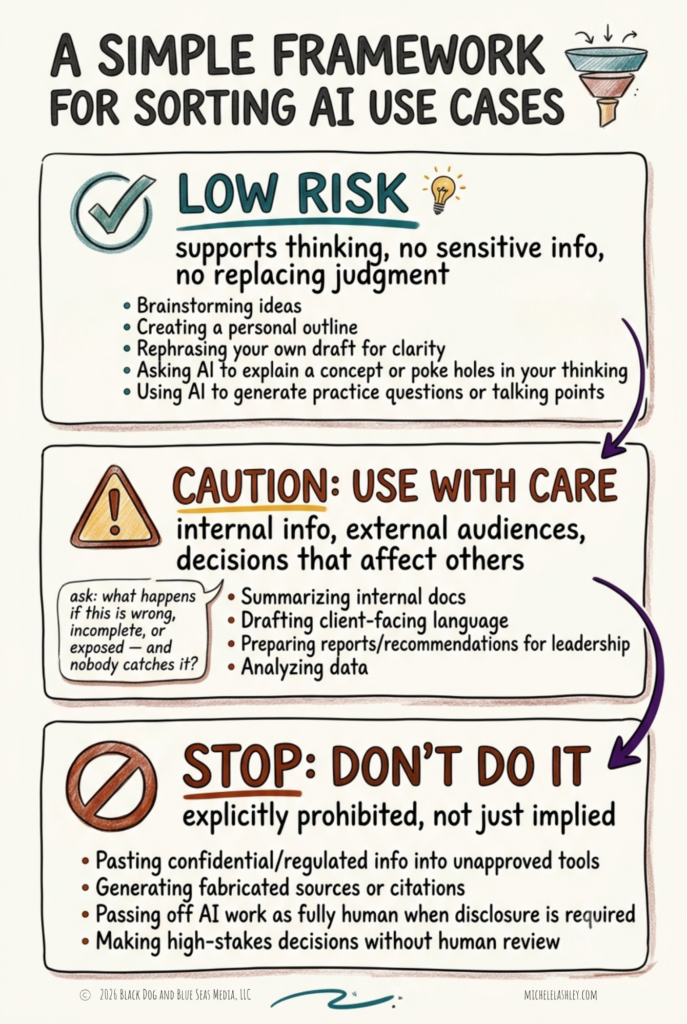
The Green/Yellow/Red framework below is one way to do this. But the point isn’t the stoplight-like labels. Instead, it’s the specificity such a framework offers. It doesn’t leave employees guessing at where the line for using AI starts and stops. Which is good, because when people don’t know where the line is, they either cross it without realizing it or stay so far back from it that they get no value from the tools at all.
If you’re going to allow employees to use AI, managers have to model what that looks like.
A culture of transparency around AI doesn’t evolve from a memo. It evolves from behavior. A manager who says, “I used AI to draft a first pass on this, then checked every line,” is doing more to normalize responsible use than any policy document ever will. If leadership never talks openly about how they use AI — or whether they use it at all — employees read that silence as a signal. Usually, the wrong one.
The through-line in all of this is the same: Whatever your AI policy is, say it out loud. Silence forces people underground. And hidden AI use is much harder to guide than AI use that’s comfortably out in the open.
A Simple Framework for Sorting AI Use Cases
Not every AI task carries the same risk. A useful starting point is sorting common use cases into three categories — and being specific enough that employees can actually apply them on any given day for any given project.
Low Risk
These are tasks where AI supports thinking without exposing sensitive information or replacing human judgment. Examples might include brainstorming ideas, creating a personal outline, rephrasing your own draft for clarity, asking AI to explain a concept or poke holes in your thinking, using AI to generate practice questions or prepare for a difficult conversation.
CAUTION: Use with Care
This level includes tasks that might be appropriate for AI usage, but require more caution because they involve internal information, external audiences, or decisions that affect other people. Examples include summarizing internal documents, drafting client-facing language, preparing reports or recommendations for leadership, analyzing data. The question to ask: What happens if this output is wrong, incomplete, or exposed — and nobody catches it?
STOP: Don’t Do It
These are uses of AI that should be explicitly prohibited, not just implied. Examples include pasting confidential, private, or regulated information into an unapproved AI tool; generating fabricated sources or citations with AI; submitting AI-generated work as entirely human-created when disclosure is required; making high-stakes decisions with AI without human review.
The goal of this Red/Yellow/Blue framework isn’t to create a surveillance culture around AI. Instead, its purpose is to make it easier to identify when AI tools should and shouldn’t be used within an organization. This can help employees feel more comfortable talking about what they’re doing with AI without feeling like they’re confessing to something.

If you want to suggest this framework to your company’s leadership team (or if you’re the leader), you can download this handy-dandy sketch that maps out the concept:
What Will It Take to Move the Comfort Needle for AI Use?
Let’s start with what won’t make employees feel more comfortable: A mandate to disclose every prompt they enter into an AI tool. This gets performative — fast. And, really, does a confession need to happen every time someone asks AI for five title options?
The skill we actually need people to build isn’t simply AI fluency. It’s judgment — knowing when to use AI, what to hand it, what to check, and when to keep your hands fully on the wheel. Nobody develops that skill in a culture where honest answers about AI use expose employees to ridicule and shame.

What can work is normalizing the AI disclosures that matter. For example, “I used AI to draft a first pass, but the analysis and the final calls are mine” is a useful sentence. It tells you exactly where human judgment was used in the thought and creation process.
And leaders have to go first. If a manager says, “I used AI to pressure-test this agenda, but I revised it myself,” members of her team will feel much more secure in talking about how they’re using AI. Modeling the behavior is more effective than any policy document, and it turbocharges positive changes in corporate culture.
AI is here. It’s not going anywhere. Employees are using it whether their supervisors know it or not. So, bringing that usage into the light and transforming it from taboo to “just another part of our workflow” is something worth considering.
Interested in learning more about how your organization can strike the right balance when it comes to using AI? Download my free guide — AI Literate. Not AI Dependent.